“Well you’re a writer,” Allan said, “you know how it is. When you want to say something, you don’t make up a new word. You put old words together in a new way. That’s essentially what we’re doing when we take a solo.”
We were sitting around my dad’s dining room table, having a conversation over the battered remains of three large pizza pies. We were there to talk about jazz.
By virtue of my father, Norman, jazz has been an unavoidable part of my life since as far back as I can remember. And though I have never been a jazz fanatic, I have consistently been astounded at the musicianship displayed by so many jazz players. Name virtually any instrument, and inevitably a jazz musician will be among the best who ever touched it.
Yet after years of training and trying, I have never been able to play a lick of it. So I had the bright idea to interview the members of the East-West Rivertowns Sextet, which meets biweekly* in my dad’s living room to play, to see what they have that I so conspicuously lack.
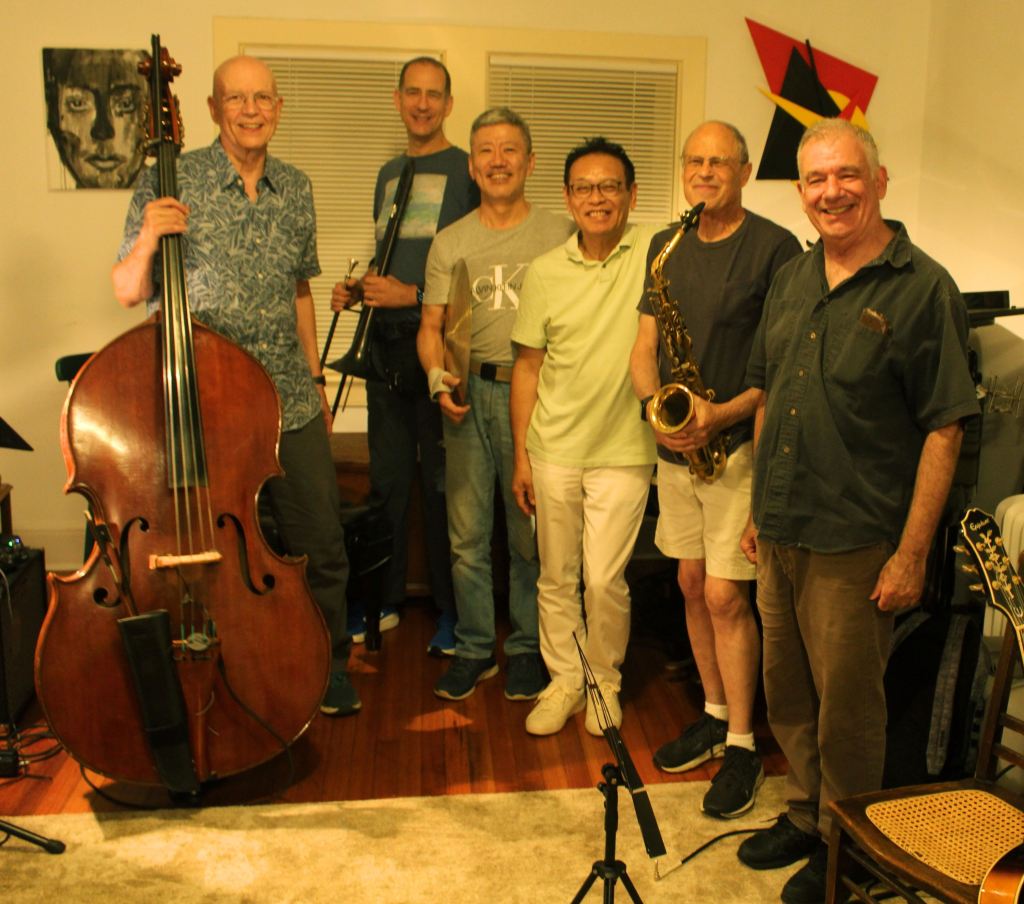
Here I should pause to introduce the players. I’ll do so in the order they usually play.
Typically, the melody is played by the horn players—in this case, trombone and saxophone. Meanwhile, the rhythm section—drums, bass, piano, and guitar—provides the harmonic cushion and percussive drive.
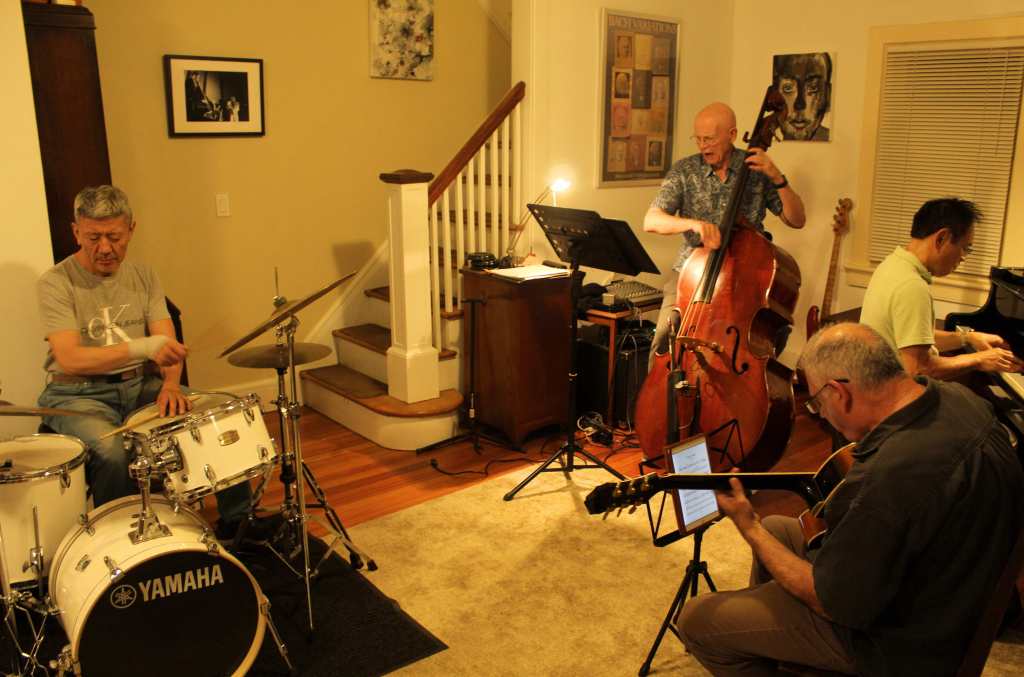
The rhythm section
Then, the solos.
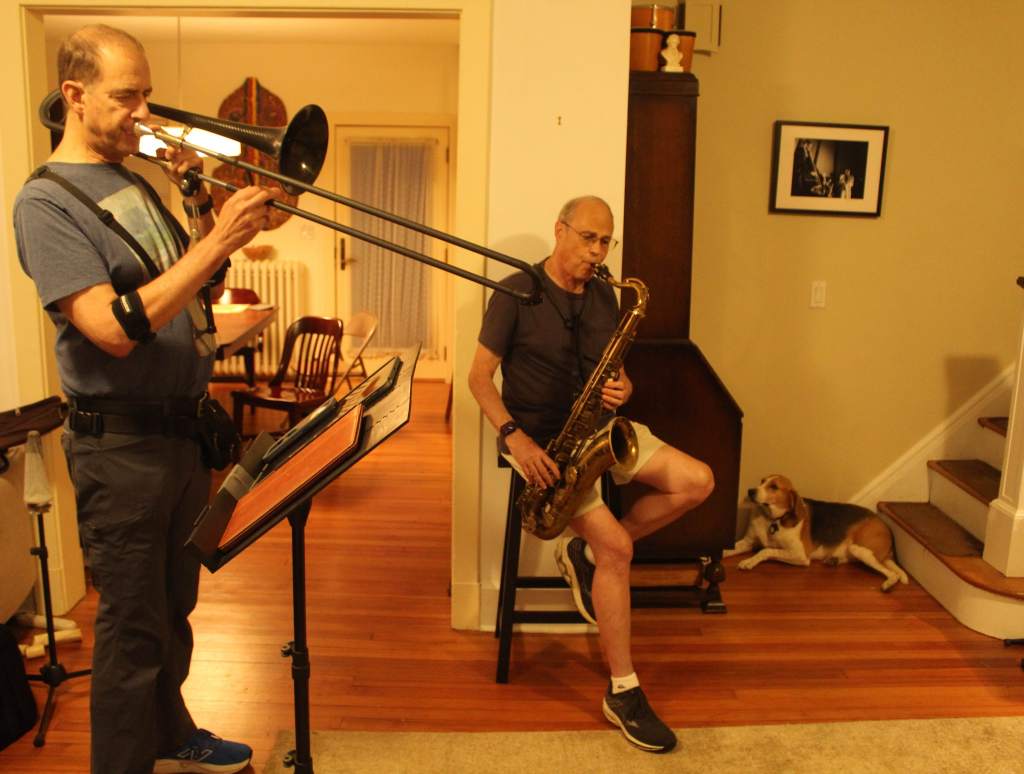
The first to bat is Allan Namery, who plays both alto and tenor sax (not an easy transition, since they’re keyed differently). As a student, Allan started on clarinet; but he early made the switch to sax. From there, jazz was almost inevitable, as all the best saxophonists are jazz players. Allan worked as a music teacher and band director in a public high school in Jersey City, and spent seemingly the rest of his time studying and playing as much jazz as humanly possible. He knows everyone, and he’s played it all.
Next it’s Alan Goidel’s turn, the trombonist. When asked why he settled on that instrument, he indicated his prodigious height. “Long arms.” Curiously, he was playing a trombone made of carbon fiber rather than brass, because it’s much lighter and easier to manage. Also a public school teacher, Alan has been playing trombone—classical, big band, latin, you name it—in New York and beyond for his whole working life.
Alan, Allan & Ollie the dog (for moral support)
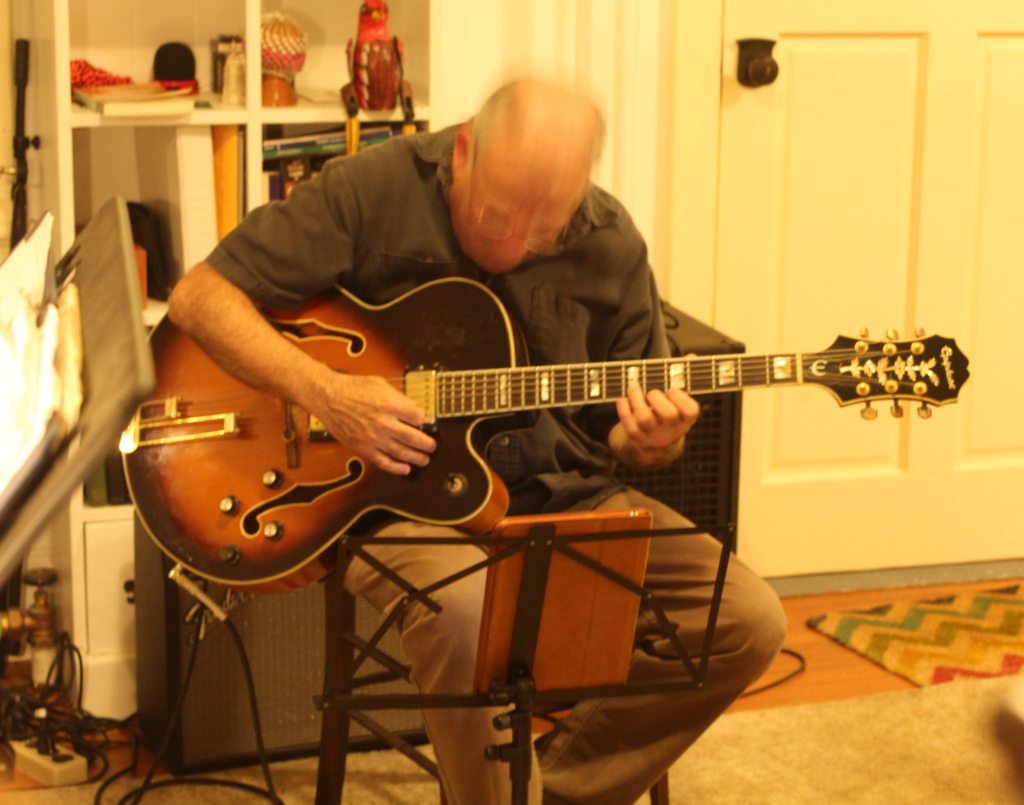
Now it’s time for Ray Machiarolla to take a guitar solo. Unusually, Ray plays with his thumb rather than a pick. When I asked him why, he said that’s just how he learned: he is mostly self-taught, modeling his style on players like Wes Montgomery, Jim Hall, and Kenny Burrell. Supplementing his income, as many musicians do, with another line of work—in his case, IT—he nevertheless has managed to play seemingly with everyone, all over the place.
Ray may be playing jazz, but he’s rocking out.
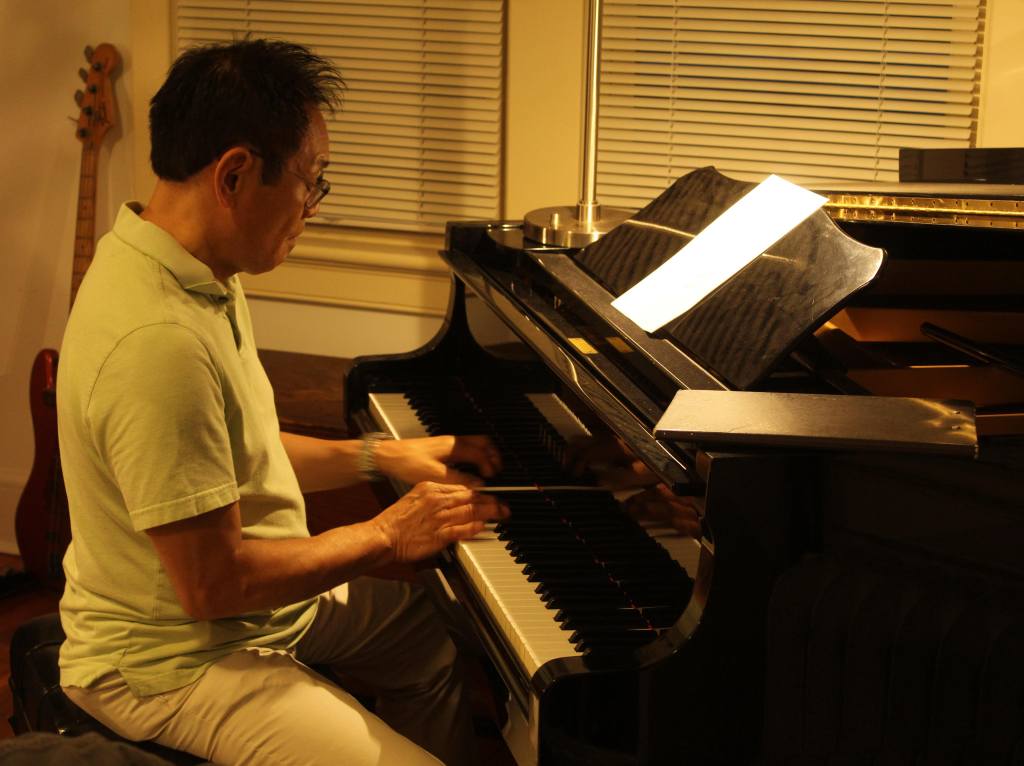
Hiroshi Yamazaki on the piano picks up where Ray left off. Hiroshi has been a musician his whole professional life, having graduated with a degree in music from Osaka College. His early musical experience was devoted to classical music. Indeed, he didn’t even hear jazz until the age of 19. But he quickly became hooked, listening to Art Blakey cassettes so often that he wore them out. He moved to the United States at the age of 30, to the East Village, in order to further his jazz career. Nowadays, when he isn’t playing, he’s teaching at the Conservatory of Westchester.
Hiroshi, deep in musical thought.
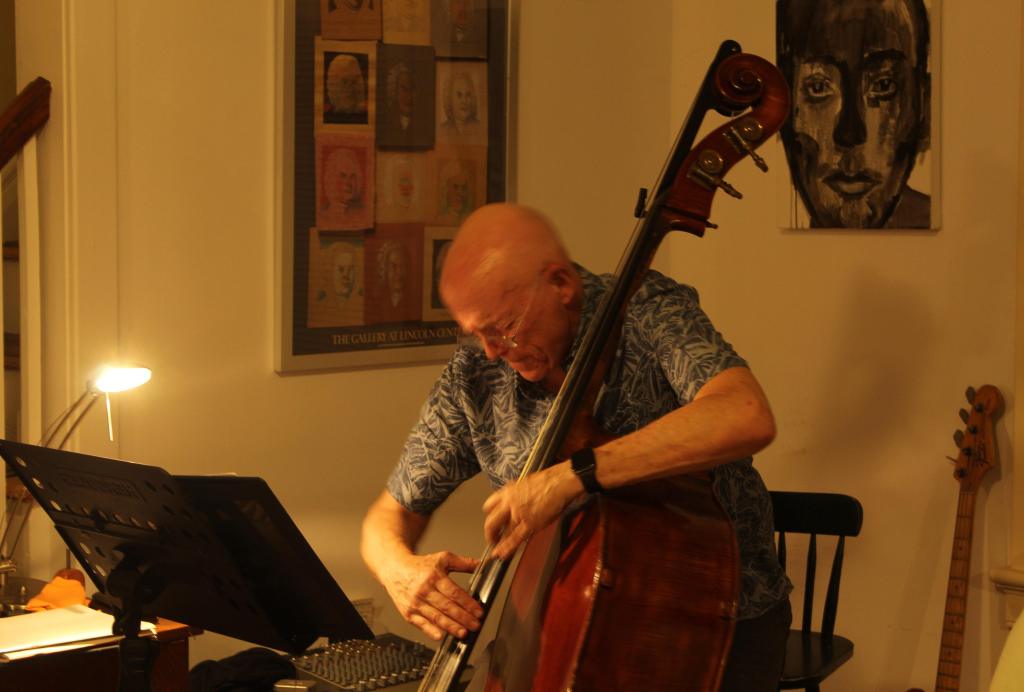
After the piano comes the bass, played by my father. As is typical in jazz, he plays an upright rather than an electric bass—a considerably larger instrument, though next to my tall dad it looks proportionate. Norm got involved in the music scene as early as he could (playing in a rock band that made the cover of Seventeen Magazine), and later on he studied both classical and jazz. But like so many musicians, my dad got himself a stable job, and has only been able to fully devote himself to music since his retirement. When asked why it’s so hard for musicians to make a living through their playing, he reminded me of the pertinent Hunter S. Thompson quote:
The music business is a cruel and shallow money trench, a long plastic hallway where thieves and pimps run free, and good men die like dogs. There’s also a negative side.
My dad, Norm, taking an art-powered solo.
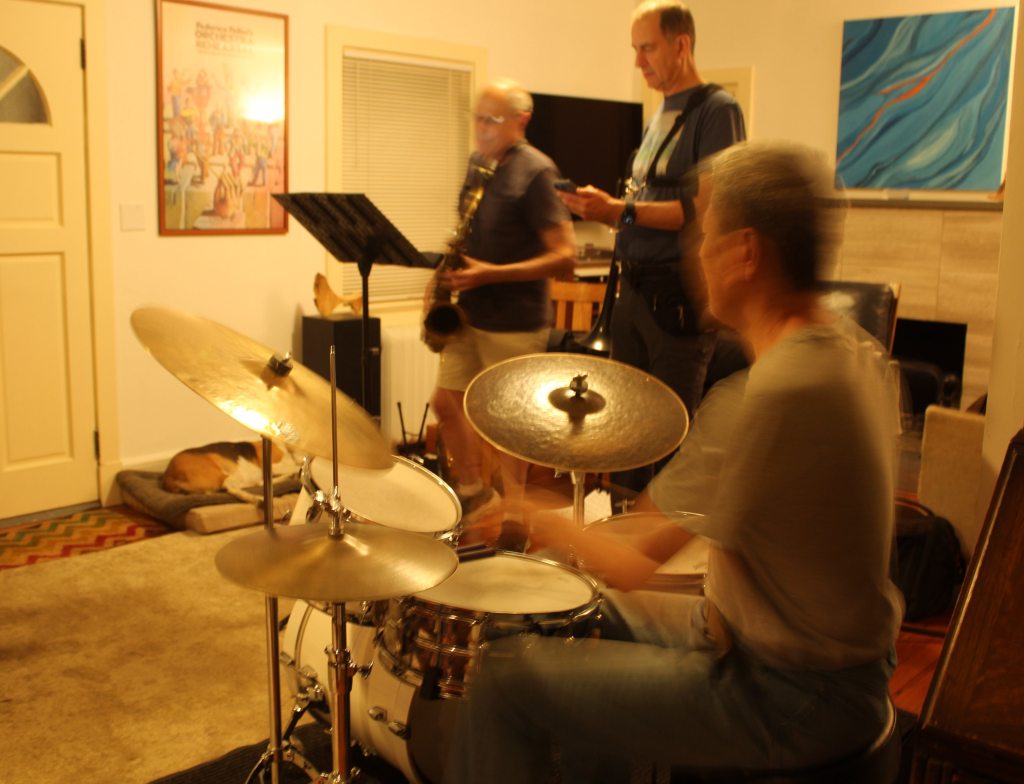
Finally we get to the drums, played by Seiji Ochiai. Another Japanese expat—hailing from the Shizuoka prefecture—Seiji began playing at the age of 16, at first in a rock band. Like me, he studied anthropology in college (and, like me, he soon discovered it wasn’t very profitable). But he commuted to Tokyo for drum lessons during his studies, and his teacher introduced him to jazz. At the age of 27, he sold nearly everything he had and came to the United States with a single suitcase. For money, he works in a studio assembling picture frames. But he plays jazz whenever he can—indeed, he makes a trip out to Taiwan every year to do some gigs there.
Seiji was too energetic to photograph!
After Seiji is finished trading eights with the other players, the horns play the melody one more time, and the tune is over.
The defining feature of jazz is improvisation. Rock or blues music may have a guitar solo, but that’s about it. In jazz, by contrast, the melody (or “head”) can be a minor feature of the song—merely a structure to organize and bookend long, elaborate solos. You can’t play jazz if you can’t improvise.
At first glance, putting together a solo may not seem too daunting. Just fiddle around on the relevant musical scales, and voilà—there’s your solo. In practice, it’s very difficult to play something that doesn’t make your ears bleed. A good solo has a sense of humor, timing, form, progression, dynamics—in short, musicality. Compare a five-minute sketch of an expert draftsman with the doodle of a preschooler, and you will get an idea of the difference between a competent and incompetent solo.
But how can any mortal musician be expected to put together a compelling melody off the top of their head? The short answer is: they don’t. As Allan suggests in the opening quote, jazz is a musical language, and good soloists take the building blocks of that language—licks, runs, quotes of other tunes, or simply their basic instincts of harmony and melody, shaped from a lifetime of playing—and use them to construct something new, yet familiar enough to be called a jazz solo.
This is perhaps not as mysterious as it sounds. This sort of structured improvisation is arguably akin to what chess masters do—memorizing thousands of situations and patterns—or how freestyle rappers train themselves to spit fire on any subject, by having a stock of rhythmic, rhyming phrases. Indeed, many scholars believe the Homeric poems emerged out of a tradition of “improvised” recitation. You may go as far as to say that this is the basic state of affairs for any artform that doesn’t rely strictly on a written medium.
Yet this is where Allan’s comparison with writing breaks down. As I pointed out, when you’re writing, you can go over and revise a sentence innumerable times, until you’re finally satisfied. The same can be said of a classical composer, or an oil painter (unless you’re Jackson Pollock), or even a pop musician doing multiple takes in the studio. Some artforms, you might say, are based on the product, while others—like jazz—are based on the process.
This was exemplified when Ray expressed his boredom with big band playing. (Big band jazz is perhaps the closest jazz comes to classical music, as much of the music is through-composed.)
“It’s just a lot of reading,” Ray said. “I get tired of reading. Can’t we just play?” Alan, the trombonist, had a revealing comment when he added: “The thing I don’t like about big band playing is that they expect you to start hot. I can’t play like that. I have to warm up into a solo.”
Another clue came when Ray said: “It’s a conversation.” By this he meant that jazz is intrinsically a group activity, and one’s playing should respond to the other members of the group.
Here I am reminded of the Enlightenment-era Parisian salons or the Bloomsbury Group (of which Virginia Woolf and John Maynard Keynes were members), in which witty, learned conversations are prized as an end in themselves. You might fancifully say that jazz musicians are doing the same, making reference to Wes Montgomery or Red Garland rather than Plato or Voltaire: a clever exchange of musical repartee.
This all adds up to a very confusing picture. On the one hand, the players downplayed the level of spontaneity required for a solo; but on the other, it was clearly important to them to be improvising their own way, and not just reading someone else’s musical ideas.
Perhaps the best way to escape this apparent dilemma was provided by the great Chick Corea. His article “The Myth of Improvisation” (which Alan recommended to me) acknowledges that, even if jazz musicians are expected to discover their solo along the way, most have a strong idea of what they are going to play beforehand. Indeed, a truly spontaneous solo would sound, according to Corea, “very erratic,” while it takes “once or twice or a hundred times before what you’re doing comes out as a flow.” What makes a solo good, then, is not its unpredictability; rather, it is the musician’s ownership and mastery of the musical ideas. In Corea’s zenful words:
There’s a myth that spontaneity has something to do with the musical phrase being different from anything that has come before. But newness is just viewing something from now, from the present moment. It doesn’t matter if the tree you’re looking at now is the same tree you looked at yesterday. If you’re looking at the tree now, it’s a new experience. That’s what life is about.
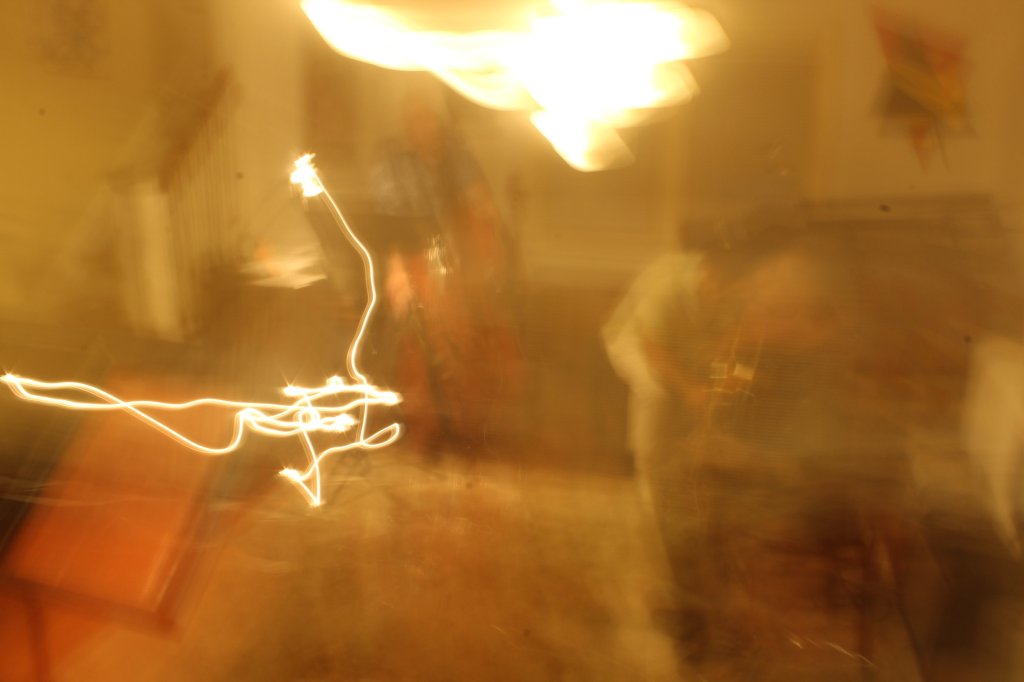
I accidentally overexposed this photo, but in the spirit of jazz I’ll include it.
Now it was time to play.
To give an adequate taste of a session, I will contrast it with how my band used to practice. Typically, we had a list of songs we would play at the next gig, and we would rehearse them again and again until they sounded halfway decent. Sometimes we played the same song a dozen times in a row. And if we jammed—as in, attempted improvisation—it was a loud, chaotic mess of feedback and dissonance.
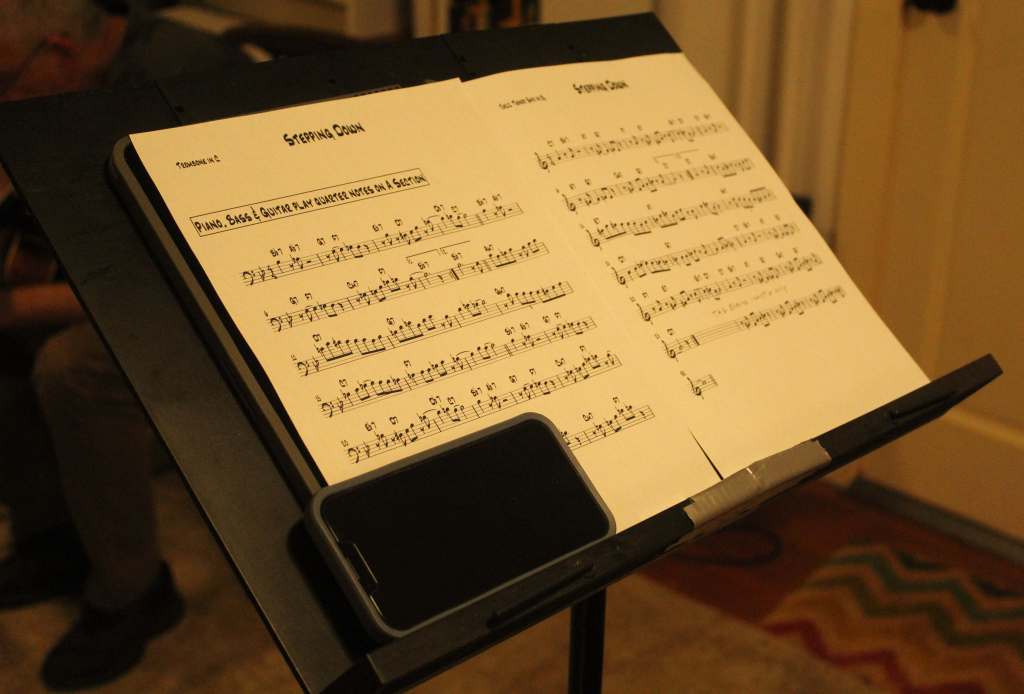
When the Rivertown Sextet plays, it is quite different. They have no set list whatsoever. Somebody calls a tune—any one of the hundreds of jazz standards—and they simply start playing, after perhaps only a few quick words on the key or the tempo. Admittedly, some of the musicians have tablets with digital lead sheets (showing the melody and chords) that can be quickly called up. But often they play from memory. According to my dad, it is common for jazz players to have hundreds—even thousands—of songs memorized, to be called up at a moment’s notice.
Hearing them, the amateur musician is amazed that there are scarcely any false starts, flubbed notes, or other breakdowns that cause them to have to stop or repeat a song. It is just tune after tune, each one played expertly, as if they had rehearsed it a thousand times.
As a case in point, three of the musicians brought in original compositions on the day I observed. Hiroshi brought in “Blues on the Street,” Alan Goidel “Steppin’ Down” (which he said he had written at 9 o’clock the night before), and Allan Namery the ballad “Urban Renewal.” In other words, there was simply no way the other musicians could have practiced the tunes beforehand. Still, it all went off without a hitch.
To further illustrate the point, after playing several songs in common time, Ray requested they do something “in 3” (as in, waltz time) to break up the monotony. Somebody suggested that they just do the song they were about to play, “This I Dig of You,” in the new time signature—a transition many musicians would find awkward—and, once again, the song was played impeccably.
It is as if these musicians had transcended the need to practice and rehearse, so fluent had they become in the idiom of jazz. They could just play. And I ask again: what do they have that I lack?
I suppose the simple, unsexy answer is that these musicians have all spent thousands of hours listening, jamming, shedding, critiquing and getting critiqued, taking classes and giving classes, bombing and smoking and burning, in order to get where they are now.
Arthur C. Clark famously said: “Any sufficiently advanced technology is indistinguishable from magic.” But it turns out that mastery can be indistinguishable from magic, too.
The East-West Rivertown Sextet
*It is among the unfortunate details of the English language that “biweekly” can mean either twice a week or every two weeks. In this case, I mean the latter.
Before launching into this review, I ought to say why I read this infamous report in the first place. I have never been particularly interested in JFK or the assassination, and thus I knew just the bare basics of the official story and the conspiracy theories. My interest in the book was actually sparked by Werner Herzog, who named the Warren Commission Report as one of his favorite books. I read the report, then, mainly to appreciate how the story is told and the conclusions are reached, rather than to find any hidden truths of the assassination.
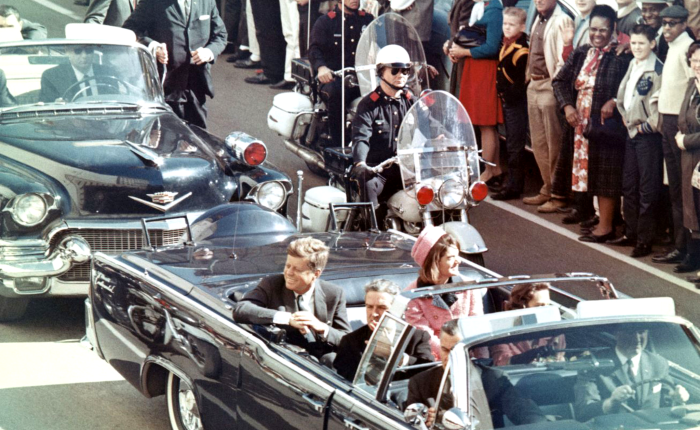
From the first pages, I could see what Herzog enjoyed about the book. In the guise of a bureaucratic, governmental document, we have an excellent true crime thriller. Unlike the overworked detectives of cop shows, the Commission had the nearly unlimited resources of the United States government at their disposal, and were able to perform any tests they wished. Expert riflemen attempted to replicate the shots; key witnesses were timed reenacting their movements; a car was driven at the exact speed as the presidential limo while pictures were taken through the scope on the rifle; the frame rate on the Zapruder film was used to determine the exact timings of the shots fired; and so on.
This way, the Commission closes in on the conclusion: it was Oswald—and only Oswald—from the sixth floor of the Texas School Book Depository. Every minute is accounted for, every movement is traced, every alternative theory is considered and discarded. It is, in short, a tour de force in the prosecutorial arts.
Yet I think this does not fully explain the report’s appeal to Herzog. Speaking purely in terms of aesthetic appreciation, what is especially compelling about the book is how grand, potentially historic conclusions follow from tiny questions of fact. Could the rifle be operated fast enough? Was the shot too difficult? How many shots were heard? Among the delights of Herzog’s best documentaries is the sensation of a profound abyss of mystery opening up in unexpected places. And the report certainly provides that sensation.
Now, I think it would be remiss of me if I did not at least attempt to comment on the plausibility of the report’s conclusions. I should say that, going into it, I was highly disposed to accept Oswald as the lone gunman. After all, we live in the era of mass shootings, most often carried out by loners with inscrutable motives. Indeed, Lee Harvey Oswald—a 24-year old white guy, a misfit with few friends—seems like the textbook example of a mass shooter. As a case in point, the would-be assassin of Donald Trump, Thomas Matthew Crooks, seems to have had a similar profile.
And the evidence linking Oswald to the crime is quite strong. There is the picture of him with the rifle, the fact that the rifle was found in his place of work, the visit to his wife the day before to pick up the rifle, the fact that he immediately fled the scene, his history of impulsive decision-making, his interest in left-wing movements, the total lack of an alibi, the multiple witnesses linking him to the subsequent murder of officer Tippit, resisting arrest shortly thereafter with a gun on his person… The list goes on.
What is more, in addition to the (apparent) lack of evidence linking Oswald to a conspiracy, several considerations seem to make such a link unlikely. For one, it is not as if JFK was a highly unusual president in terms of his politics. If Kennedy had been proposing something truly radical—provoking a nuclear war with the USSR, say, or instigating a communist revolution in the USA—then I could imagine a sizable contingent of disloyal personnel who might want him dead. But the fact is that JFK was a liberal anti-communist, and he was succeeded by… LBJ, a liberal anti-communist.
As for the Soviet Union, they would appear to have had little to gain and much to lose by getting involved in an assassination attempt, since discovery could provoke a massive war, and success did not materially benefit them in any way. The connection with Cuba is admittedly plausible, if only because of Kennedy’s many dealings with the country (the Bay of Pigs invasion, the Missile Crisis, attempted CIA assassinations of Castro…).
As for LBJ, though he was as power-hungry as they come, and had a penchant for unscrupulous behavior, it is frankly difficult for me to believe that, as Vice-President, he could have wooed away enough government agents, and sworn them all to absolute secrecy, in the service of his personal ambition. A single whistle-blower would have toppled the plan—and humans are bad at keeping secrets.
This is all to say that I found the report extremely believable. But in the interest of fairness, I decided to watch the first major documentary questioning the conclusions of the report: Rush to Judgment. This is the film version of a 1966 book by Mark Lane, a lawyer. And its premise is, I think, a fair one. If the Warren Commission was the posthumous prosecution, Oswald also deserved a posthumous defense, which Lane intended to provide.
To start, I think it is only fair to point out some considerations that undermine the report’s conclusions. The most conspicuous one is that LBJ created the Commission to prove to the public that Oswald was the lone gunman, in order, in his words, to avoid a war that could “kill 40 million Americans in an hour.” That is to say that the Commission worked to prove a foregone conclusion, ostensibly to avoid a crisis in international relations. And, of course, the killing of Oswald by Jack Ruby before he could be tried cannot help but raise eyebrows.
In his documentary, Mark Lane interviews several witnesses whose testimony does not conform with the official story. Many people from different vantage points report hearing the shots from—you guessed it—the grassy knoll, and some even said they saw smoke in the air. Mark Lane also probes potential connections between Jack Ruby and the Dallas Police Department, including officer Tippit, and he portrays the so-called “magic bullet” theory (namely, that a single bullet pierced Kennedy’s neck and wounded Governor Connally) as being inconsistent with the evidence.
For me, the contrary eye- and earwitness testimony is fairly easy to discount. In such a chaotic environment, with people running everywhere, several vehicles on the road, and many hard surfaces for sounds to reflect from, I think it would be difficult for an unprepared observer to localize the source of a sound or even to make a precise count of the shots. In any case, given the somewhat contradictory testimony, many people simply must be mistaken.
The argument that Oswald was not a good enough marksman also strikes me as weak. Oswald had military training, an accurate weapon, and in any case there’s always an element of luck involved. (Thomas Matthew Crooks missed by a fraction of an inch—the difference between a historic turning point and a footnote.)
Many conspiracy theories rely on a close examination of the Zapruder film. Among the arguments made are that Kennedy jerks back instead of forward in response to the lethal shot to his head (indicating it came from in front and not behind), and that Connally seems to react the first shot—the “magic bullet”—a couple seconds after Kennedy clutches his throat.
For what it’s worth, to my eyes it does look like the president is shot in the head from behind (it’s gruesome to watch). But the timing problem between Kennedy’s and Connally’s initial reactions is harder to explain if they were, indeed, struck by the same bullet. In fact, what the film apparently shows does correspond with how Connally remembered the event: hearing a shot, turning to his right to check on Kennedy, and then getting shot himself before the final, fatal shot to the president.
This would seem to indicate three shots: the first hitting Kennedy in the neck, the second hitting Connally in the back, and the third lethally wounding Kennedy in the head. The problem with that sequence is that the bullet exiting Kennedy’s neck would have caused substantial damage to the inside of the car, had it not hit another person. What’s more, given the constraints of the bolt-action Carcano rifle used in the attack, it seems almost impossible that three shots could have been gotten off in such quick succession. Thus the single-bullet theory.
I think it would be dishonest of me to say that I know enough about ballistics, marksmanship, firearms, traumatic wounds, or any other pertinent subject to venture my own explanation. (And I think I will probably regret even touching my toes into this vast reservoir of fevered speculation.) I will say, however, that the popular theory of a second shooter wouldn’t explain the lack of damage to the inside of the car—not to mention requiring the supposed second shooter to fire in such close coordination with Oswald as to be basically indistinguishable.
To round out this review, I should mention the bevy of documents made available to the public, starting in the 90s and as recently as last year. One of the strangest findings concerns a trip that Oswald made in late September and early October of 1963—in other words, shortly before the assassination—to Mexico City, in order to obtain a visa to either the Soviet Union or Cuba. Both of those embassies were being closely monitored by the CIA, and apparently somebody was caught on tape impersonating Oswald in phone calls. This was subsequently denied and covered up by the CIA. I really have no idea what that might mean.
There are approximately one million other stories and rumors—involving the Mafia, Jack Ruby, Officer Tippit, failed assassination attempts, murdered witnesses, and so on—which no single person could summarize or evaluate.
For me, I come back to my general skepticism of conspiracy theories, which is founded on my unshakable belief in human incompetence. Any task that requires a large number of people to work together and keep absolute secrecy arouses my suspicion. Aside from that, it seems that Oswald would be a uniquely bad co-conspirator. As the report points out, he attracted the notice of law enforcement everywhere he went; and his arrogance and impulsiveness made him difficult to work with. Given what is known about Oswald, he doesn’t seem to be the sort of person to be recruited for a secret operation.
I am also wary of the strong psychological pull of conspiracy theories. The idea that a lone gunman could change history—for the murkiest of motives—is inherently unsatisfying. Only connoisseurs of the absurd (like Herzog) could relish the fact that luck and chance can play such a defining role in our lives. I think it is significant that both Reagan’s and Trump’s attempted assassination have received far less attention from amateur sleuths, for the simple reason that their assailants failed while Oswald accomplished his grim task.
That being said, I also think that the members of the Warren Commission did not act as pure factfinders, but as prosecutors of the lone gunman theory. In so doing, they worked closely with the Secret Service, CIA, and FBI, rather than using their own investigators. And it seems clear that the FBI and CIA were not entirely truthful about what they knew about Oswald in the wake of the assassination.
If there was a cover-up, however, that does not necessarily mean there was a full-blown conspiracy. Governments can keep secrets simply to avoid looking incompetent, or to protect clandestine sources of information, or to avoid diplomatic crises, or simply out of a reflexive furtiveness, or for any number of reasons. As a case in point, the weather balloon explanation of the Roswell incident was, indeed, revealed to be a cover story—not of aliens, but of a top-secret balloon apparatus to detect atomic research.
Yet if there is a lesson to be learned from the Kennedy assassination, it is arguably the same rather boring lesson taught by the attempted Trump assassination: the need for better presidential protection.
This book has been on my shelf for years, but I was waiting for the perfect moment. My plan was to tackle it during the summer of a presidential election, to fully appreciate the book’s insights. But COVID prevented me from coming home during the last race, and so the book languished until the next election.
And here we are. When I read the first page of this book, Biden was still the presumptive Democratic nominee. It was the week after his disastrous debate on June 27th, in which he appeared so manifestly senile that he instantly lost the confidence of his party. Indeed, I think I may have begun the book on the day of his interview with George Stephanopoulos, wherein he tried to reassure his supports that he had merely had an “off night.” That proved unconvincing.
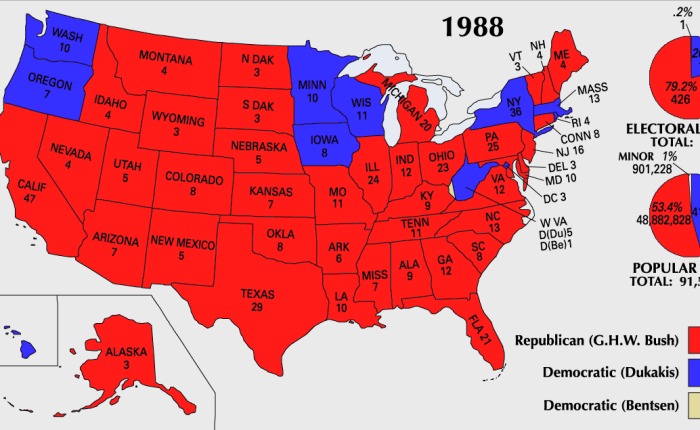
As disheartened as I was by the situation on the Democratic ticket, it was a pleasure to have Biden’s backstory so compellingly detailed in this volume. For Biden made a notable run back in 1988, thirty-six years ago, as a relatively young man. Curiously, his campaign then was derailed by another—and much different—scandal: plagiarism. The press found out that he had been accused of copying a paper in law school, and he had the bad habit of quoting other politicians in his speeches without always giving them credit.
The Democratic ticket was rocked by another scandal that year, that of Gary Hart’s infidelity. The heavy favorite to win, Hart appeared untouchable until he was caught with Donna Rice—a beautiful young woman who was, notably, not Hart’s wife. After trying and failing to deny and prevaricate, he dropped out—only to reenter the race months later, with virtually no hope of winning.
Biden and Hart are only two of the four Democrats whom Richard Ben Cramer profiles in this behemoth of political reporting. The other two are Dick Gephardt, the representative from Missouri, and the eventual nominee, Michael Dukakis, governor of Massachusetts. To this Cramer adds two Republican candidates: Bob Dole and George H.W. Bush. Each man gets ample space, as Cramer takes us from their respective childhoods, through the primaries, all the way to the big day in November.
In this monumental story, some themes stand out. One is that of personal tragedy. Bob Dole suffered horrendous injuries during the Italian campaign of World War II, recovering the use of his arms and legs slowly and painfully over a period of years. Joe Biden suffered a grievous loss when his first wife Neilia and one-year-old daughter Noemi died in a car crash. Added to that, he suffered a life-threatening brain aneurism shortly after dropping out of the 1988 race. Dick Gephardt’s son, Matt, barely survived a bout with cancer, while Dukakis and Hart both had troubled marriages, if for different reasons (Dukakis’s wife, Kitty, was an addict, while Hart… you know that story).
If there is one candidate unmarked by personal tragedy, it is the eventual winner, George H.W. Bush. True, he was shot down in the Pacific during World War II, but the rest of his career was success followed by success. Indeed, he is described by Cramer as a relentless optimist whose entire strategy in life consisted of being as affable as possible. It seemed to have worked for him.
Another major theme in this book is the press. Both Biden and Hart are eaten alive by scandals (amusingly, by scandals which probably wouldn’t even register in today’s news cycle)—a single, arguably irrelevant misstep leading to a kind of journalistic feeding frenzy that destroys their public image. The other campaigners avoid that fate, but still must contend with the dangers of the Fourth Estate. A casual, offhand remark can be misinterpreted, misunderstood, and blown out of proportion. An ill-conceived image—such as Dukakis in the tank—can (excuse me) tank a campaign. And as journalists search for a compelling Narrative, all of the words or actions of a candidate can be twisted to fit into a preconceived caricature.
But if the book has a single, guiding idea, it is the exploration of how personality is reflected in politics. Each of the candidates is strikingly different, and these differences shape their campaigns. Biden is stubborn, ambitious, and focused on his close circle of family (qualities which have not changed!). Hart is intellectual, idealistic, analytical, while Gephardt is surprisingly suggestible and somewhat vapid (he would later become a Big Oil lobbyist, undermining all the causes he previously supported). Michael Dukakis is conceited, perfectionist, correct to a fault, and intolerant of human frailties. Bush is almost canine in his loyalty and friendliness, while Bob Dole is… well, Dole is a character.
If Cramer has a thesis to prove, then, it is that the eventual success or failure of the campaigns—despite all the ads, consultants, rallies, volunteers, town halls, fundraisers—ultimately comes down to personality, to the bedrock of individual character. And he proves this, not through argument, but through convincing, play-by-play, blow-by-blow narration of the campaigns.
I should comment on the book’s style. Some prose is to be sipped, while some is to be gulped. Cramer’s prose is like an Olympic-sized pool, in which the reader thrashes about. He writes with such energy, and such an abundance of detail, that it is as if the chain-smoking, hopped up reporter is breathlessly dictating a telegraph into your eardrum. Paradoxically, however, although each sentence crashes into the next, the book itself has very little forward momentum—perhaps because he must switch focus so often, or perhaps just because the race is a foregone conclusion.
As far as political analysis goes, the only book I can easily compare it to is Robert Caro’s Means of Ascent—another masterpiece on an American election. The differences are pronounced. Caro focuses far more on questions of strategy—on how LBJ spoke to voters, traveled the countryside, gathered money, crafted ads, and—yes—stole votes in order to secure his victory. Cramer’s book feels light in comparison, focusing as it does on foibles of personality, with the machinery of the campaign in the background. Even so, this book was a terrific read, providing me a kind of historical baseline from which to compare the present campaign. We seem to have gotten considerably weirder in the interim.
The guy at the bagel store had noticed my camera. I was in Inwood, far uptown, waiting for my friend Greg.
“Oh, you know. A bit of everything, I guess.”
“Got any kind of social media I can follow?”
Very flattered, I typed in my Instagram on his proffered phone.
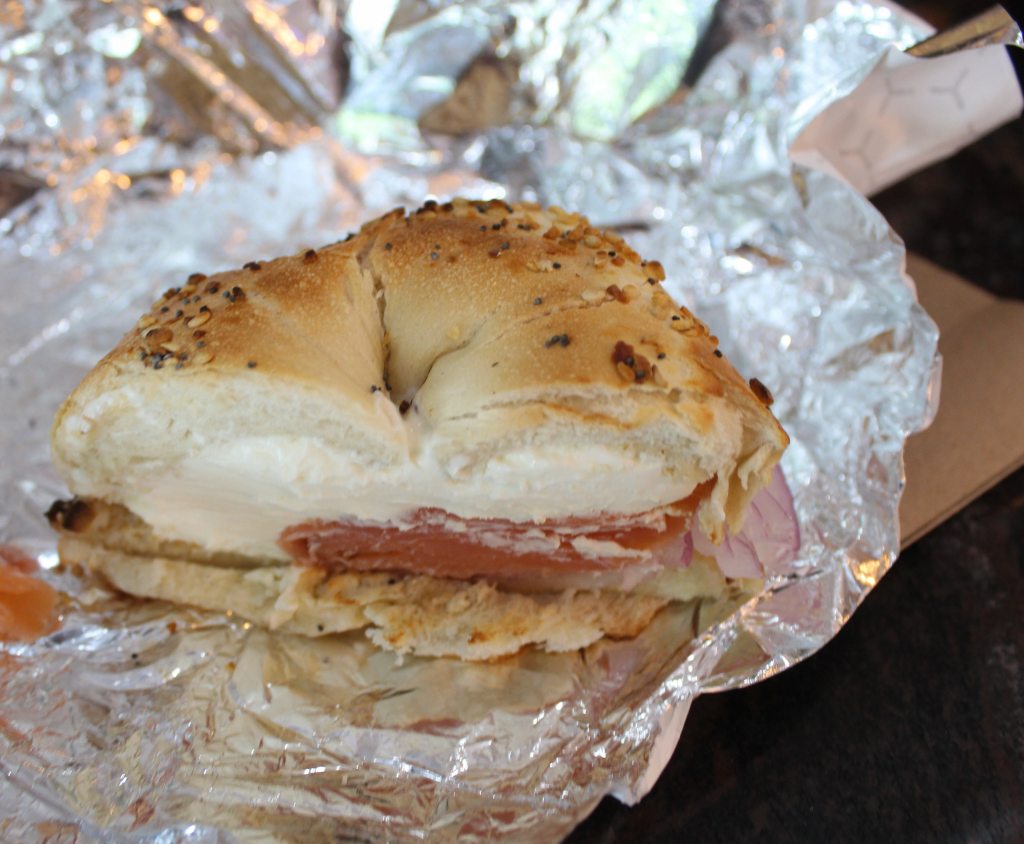
“I’m not famous or anything,” I said, and took another bite of my bagel—everything, with lox, cream cheese, and onions. A New York classic.
“I’m sure you got a lotta stories with these photos, boss,” he said, very kindly.
I tried to say “thank you” but, mid chew, only managed “thnnn ynnn.”
Greg arrived five minutes later. After ordering something for himself—“There is only one type of bagel,” he proclaimed: “everything”—we headed out. We were starting our walk to the bottom of Manhattan.
At my insistence, we had started late. I hate getting up early on the weekend, and so I set our rendezvous for 1 p.m.—which, of course, meant that we didn’t get moving until 1:30.
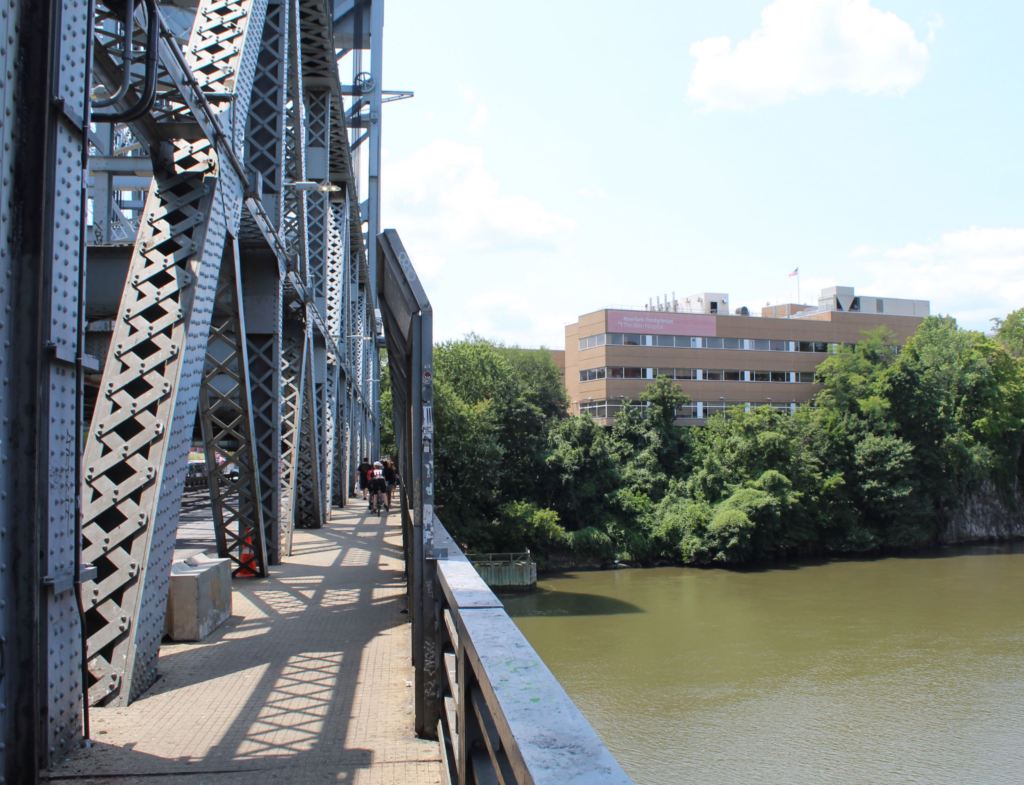
Where I began the walk, at Marble Hill, walking over the East River.
It was a brilliant summer day, hot but not too hot, and blessedly not humid. Our plan, if it deserved the name, was to follow Broadway all the way from the East River to The Battery. However, we also had an agreement—nearly fatal—that we would stop at anything that caught our eye. This happened almost immediately.
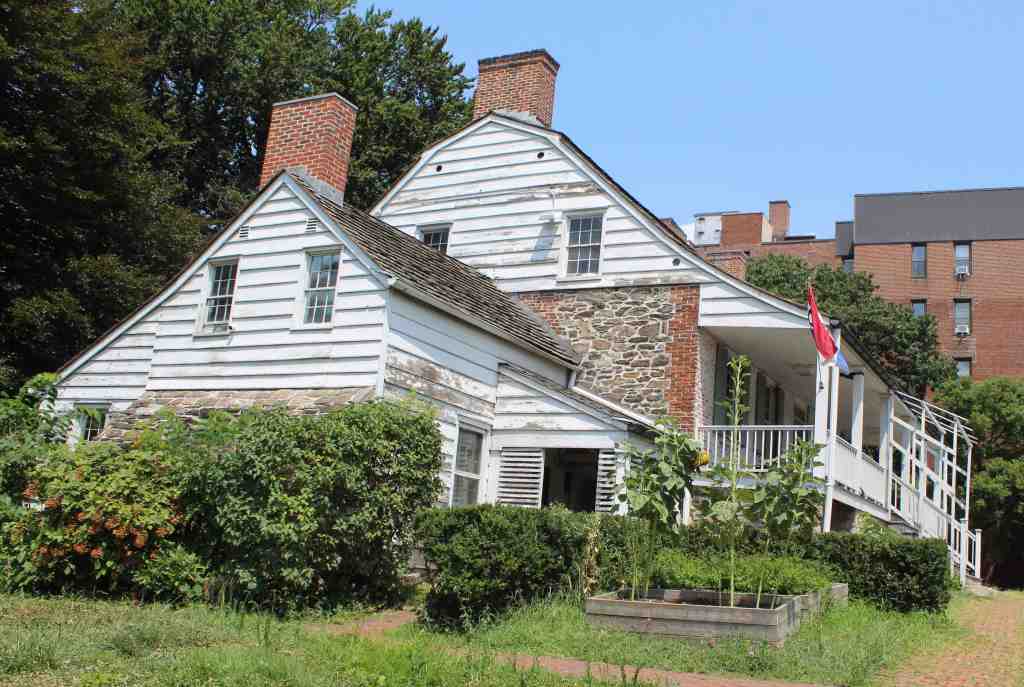
To our right, we noticed an old wooden house that looked jarringly out of place. A sign proclaimed it Dyckman Farm, the oldest—and possibly, the only—extant farmhouse on the island of Manhattan. Naturally, we had to visit.
The Dyckman family was of old Dutch stock, having arrived in the 1600s. During the Revolutionary War, however, they fled upstate to avoid the British occupation, returning later to find their original property destroyed. Thus, the current structure dates from around 1785.
Yet the description did not focus exclusively on this family, instead devoting ample space to the many enslaved people who worked and lived on the property, as well as the indigenous people who lived here before. “This is definitely not how it would’ve been described when we were kids,” Greg remarked, quite truly.
The visit cost us $3 and was short and sweet. Two things stick out in my memory. One was a small exhibit about the games that were played by the family, including a playable set of nine men’s morris—a board game even older than chess—with rules printed on the wall. If we had more time, we would’ve had a go. Upstairs, in the bedroom, the walls were decorated with “samplers,” which were embroidered fabrics meant to showcase the skill, class, and devotion of a young woman, in order to secure a favorable match. Tinder profiles seem more efficient, though perhaps less worthy to be deemed family heirlooms.
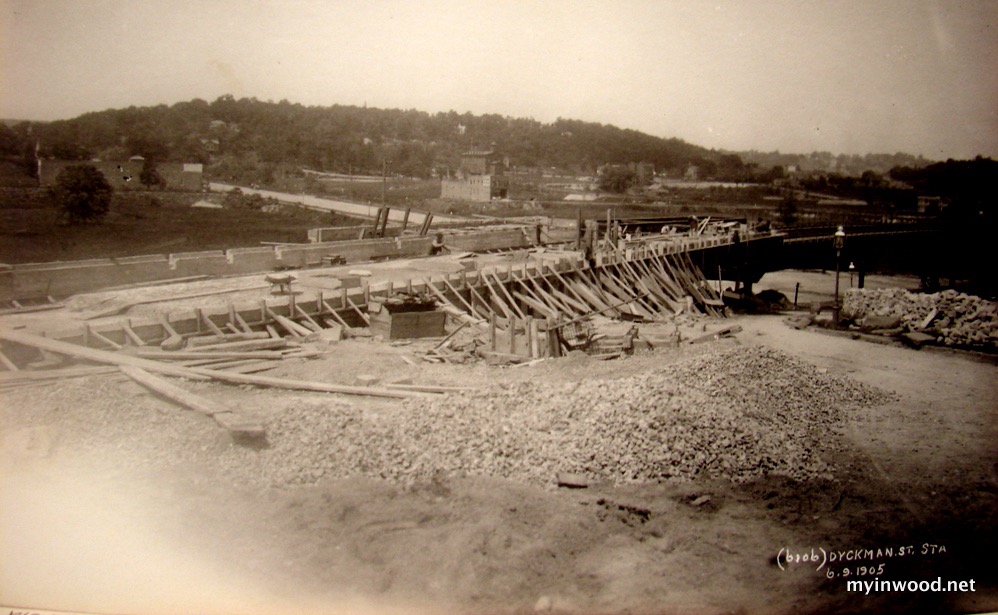
Yet, for me, the most startling item on display had nothing to do with the farm at all. It was a photograph of the construction of the Dyckman Street subway station, from 1905. What is striking about the image is the almost complete lack of a visible urban presence. It is a stunning reminder of how recent the city’s explosive growth has been. (The photo also intrigues for the apparently nonsensical decision to build public transit into empty land—a paradox resolved by the assurance that the land would be quickly populated once the subway was up and running.)
It is hard to believe that Manhattan ever looked like this.
Our walk continued. Broadway took us alongside Fort Tryon Park, a lovely green space overlooking the Hudson River. We briefly considered visiting the Met Cloisters, which sits atop the large hill, but wisely decided it would take too much time.
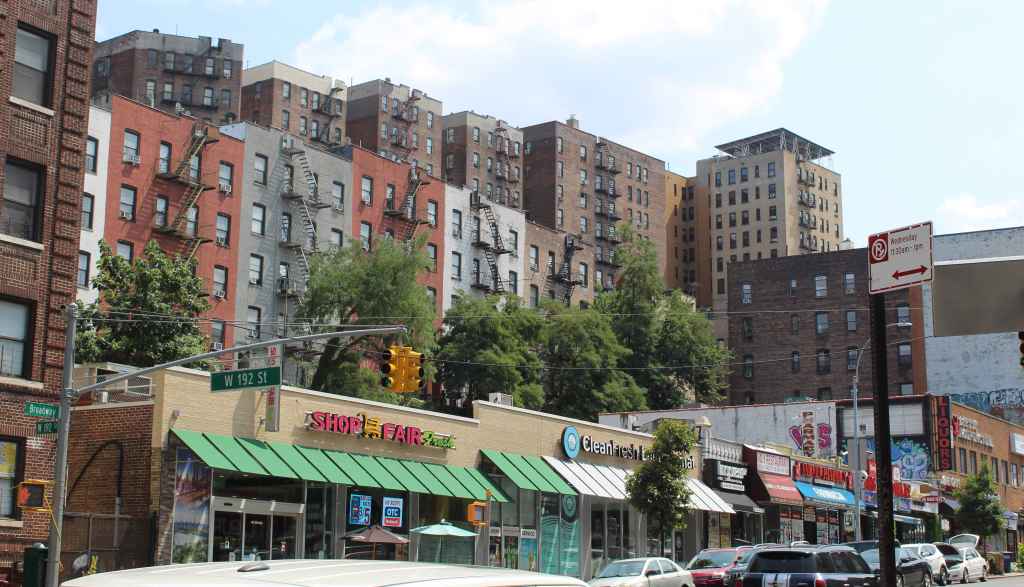
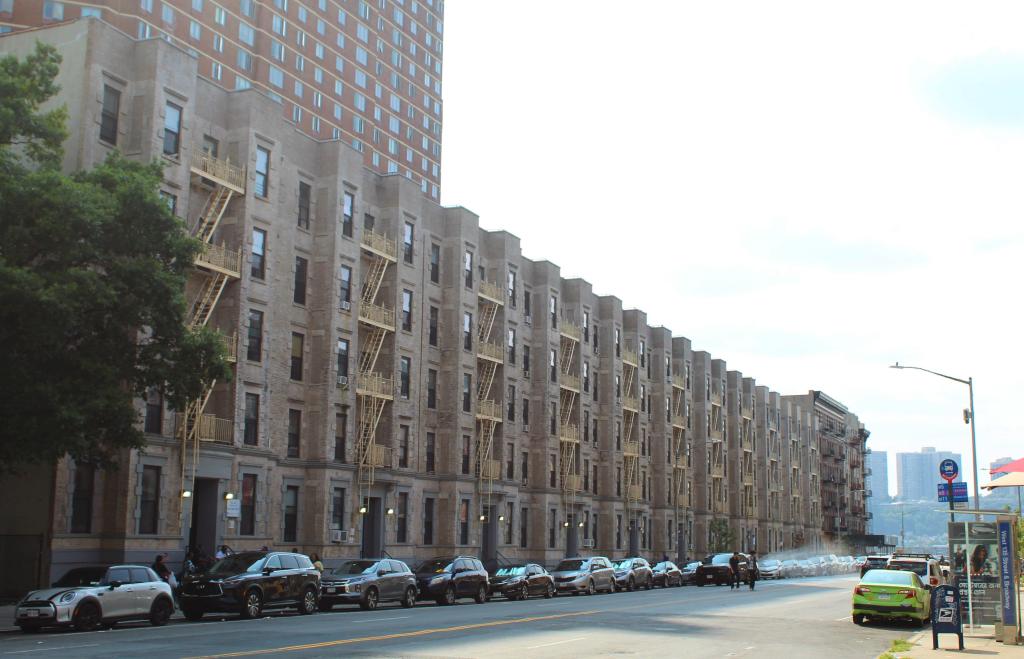
Now we were in the Heights. Manhattan above Harlem hardly feels like Manhattan at all. It is another world, an outer borough. With a few exceptions, the buildings are just a few stories tall, and there are virtually no tourists to speak of. This part of town is predominantly Latino. You see just as much Spanish as English in store windows, and hear more of it spoken in the streets. Men in tank tops, sitting on folding chairs, play dominoes on the sidewalk as if it were their front lawn. At one point, we passed by a family having a full-blown cookout, with giant trays of spaghetti and rice and beans. The food looked so good that I was a millimeter away from asking for a plate—when my better judgment forced my legs to keep walking.
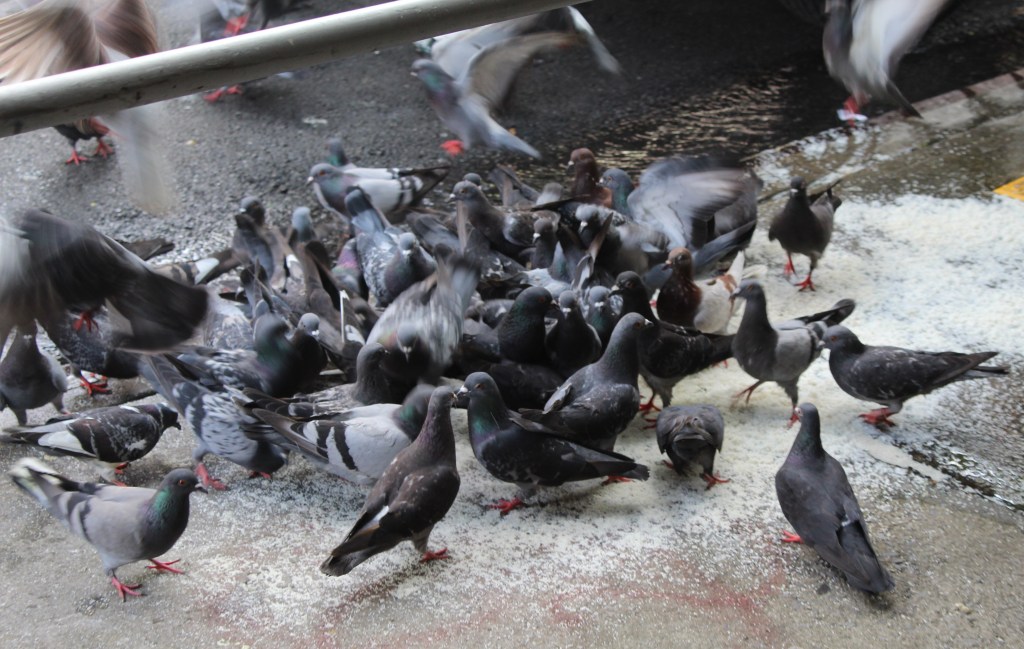
On any walk through Manhattan, there are some sights that are unavoidable. A fire hydrant leaking water into the streets, for example, or some pigeons having a feeding frenzy. Rats dart from beneath giant mounds of reeking garbage bags. Orange funnels in the street ooze steam into the air—a byproduct of Con Edison’s massive steam heating system belowground—and identical wooden water towers sit inexplicably above every tall building.
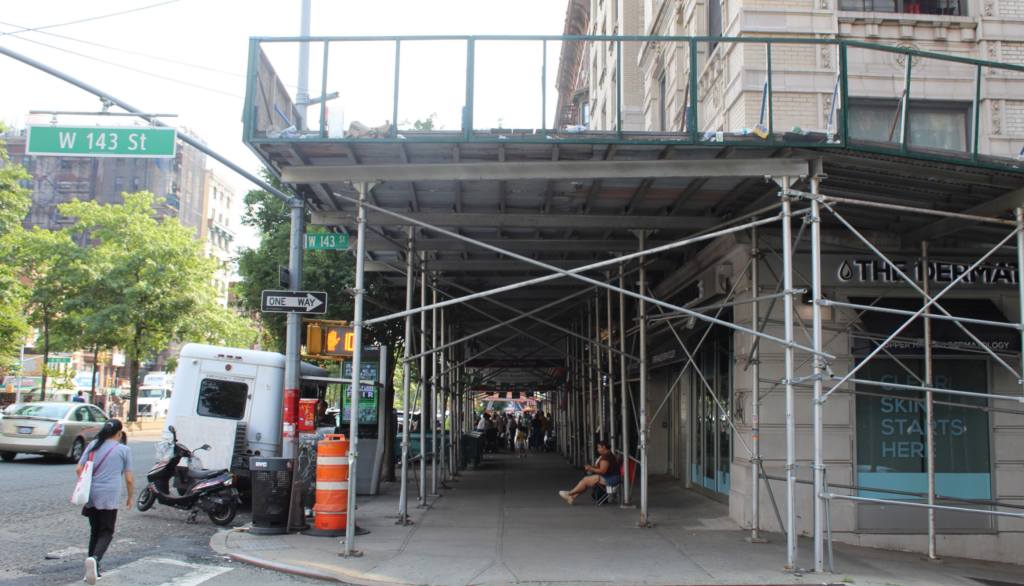
But perhaps the most omnipresent Manhattan sight is scaffolding. There are about 400 miles of it in New York City, on seemingly every other building. Remarking on this, Greg recommended John Wilson’s episode on scaffolding, which is a deep dive into the surprisingly strange world of pedestrian protection. I second the recommendation. But here is the short version.
Scaffolding: a ubiquitous sight in Manhattan
In 1979, Grace Gold, a freshman student at Barnard College, was tragically killed when a piece of debris fell off a building, striking her in the head. This led her older sister, Lori, to a dogged campaign to prevent further tragedies, culminating in the passing of Local Law 11. This mandates the inspection and maintenance of the façades of buildings over six floors tall, every five years. During this work, scaffolds (also called sidewalk sheds) are put up to protect pedestrians below.
The scaffolds present a kind of obstacle course for the pedestrian. Sometimes they provide needed shade, or a place to lean and hang out; and for many New Yorkers, they become a kind of outdoor living room. They can also narrow the sidewalk and cut off pathways, creating annoying detours and bottlenecks. Businesses hate them for decreasing foot traffic, and tourists for ruining photos of iconic buildings.
This time around, it struck me how nearly all of these classic elements of the city—the garbage bags, the water towers, the steam vents, the scaffolds, and even the fire escapes—are absent from the other city I know best: Madrid. Indeed, they are absent from most other American cities, too. Yet when I lived in New York, it never even occurred to me that these features could be unique or identifying.
Now, I have created my own detour, and must return to the walk.
Our first major city landmark was the George Washington Bridge. We passed underneath the busiest bridge in the world and were immediately waylaid by some street vendors. Greg got himself a ring and an outrageous bracelet—successfully bargaining down the price—and we were off again, heading towards Harlem.
Broadway does not take you through any of the most iconic spots in Harlem, which are further east. But it does run by one of the most grandiose and least-known museums in the city: the Hispanic Society of America.
As I’ve mentioned elsewhere, its name is somewhat misleading. Though it is in a “hispanic” neighborhood, the museum is mainly devoted to Spanish cultural heritage; and is not, and has never been, a learned “society.”
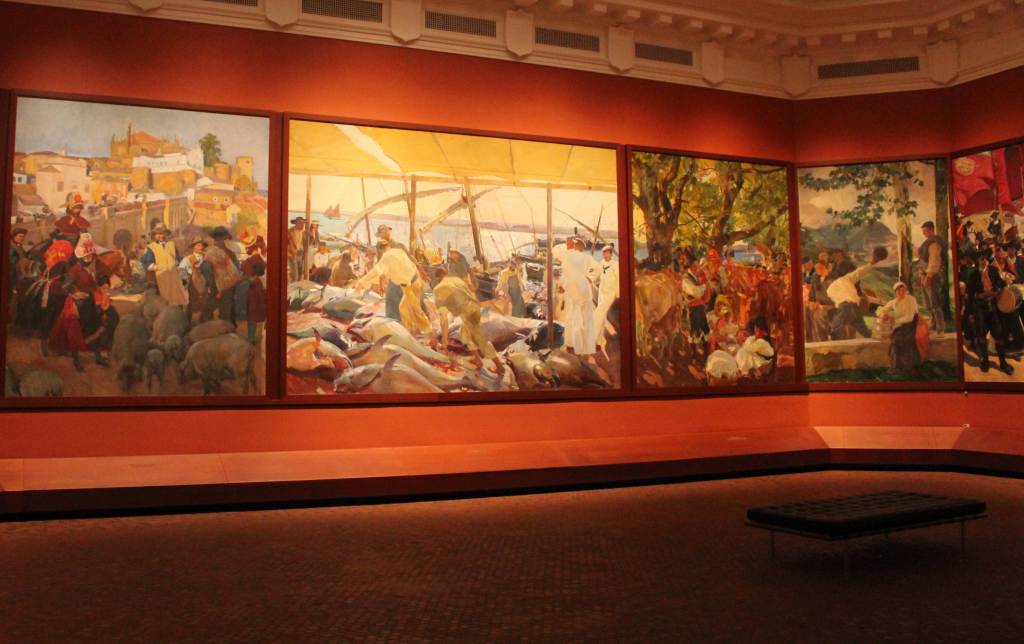
The museum is housed in Audubon Terrace, a beautiful beaux-arts complex of buildings. And though it is still not fully open after its years-long renovation, it is free to visit, and was a very pleasant place to cool off for a few minutes. For me, it is a measure of the city’s internationalism that, on top of all of the cultures and countries represented in its boroughs and neighborhoods, I can find a panoramic series of paintings depicting all of the regions of my new homeland—by one of Spain’s greatest painters.
Broadway took us within striking distance of two other Harlem landmarks—Hamilton’s Grange and City College’s magnificent neogothic campus—but we powered on, down to 125th street, where we knew a bar with an excellent happy-hour deal on wine. My brother, Jay (who had previously done this walk, and so didn’t want to subject himself to it again), would meet us there, as Greg and I tried to limit our wine intake so as not to sabotage the journey.
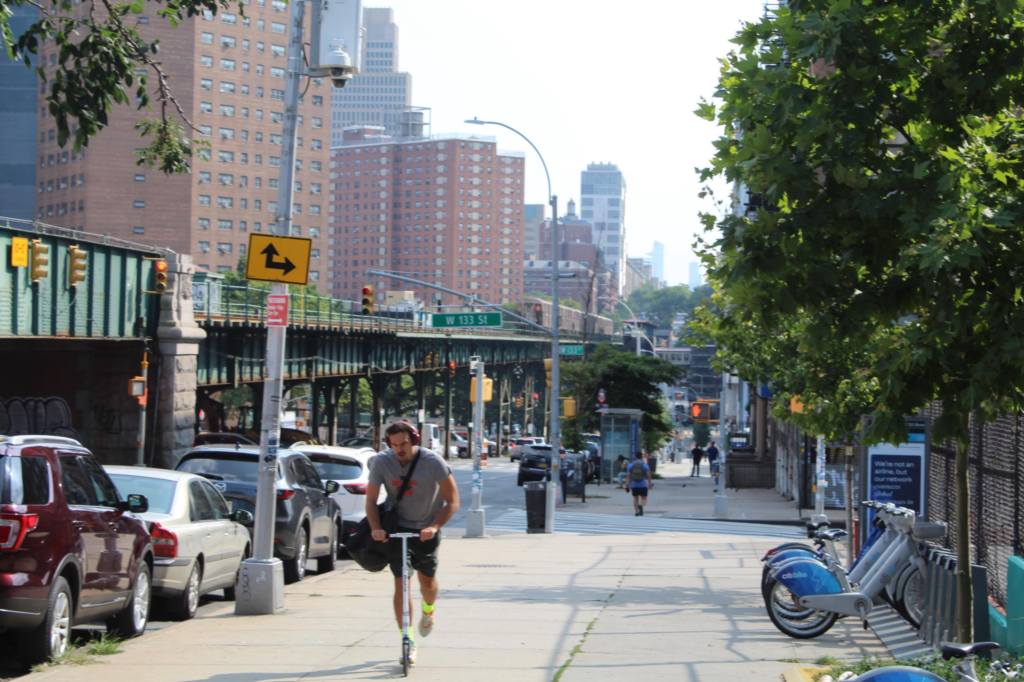
This is, coincidentally, one of the most picturesque stretches of Broadway. The street dips low and then rises up again, which forces the adjacent Subway Line 1 to briefly become elevated above-ground. A century ago, Manhattan actually resembled Chicago in its plethora of elevated metro lines; but most train lines have since been moved underground.
For my part, though I can understand hating the noise and resenting the obstructed views, I think there is something remarkably charming about these elevated lines. The criss-crossing steel beams, looming overhead, evoke a moment in industrial history when technology was both gritty and excitingly new. And the view from the train is certainly better. In any case, the large arch over West 125th Street is worthy of a poem.
As you get into Harlem, one sight becomes omnipresent: public housing. These mainly take the form of square, red-brick buildings, surrounded by small grassy lawns. Admittedly, most of my knowledge of these housing projects comes from reading The Power Broker, wherein Caro describes how Robert Moses destroyed old neighborhoods to make way for soulless housing that was, in many respects, worse than what it replaced. But as the city—and, especially, Manhattan—confronts an ever-worsening housing crisis, it occurs to me that we may have to give the idea of public housing another look.
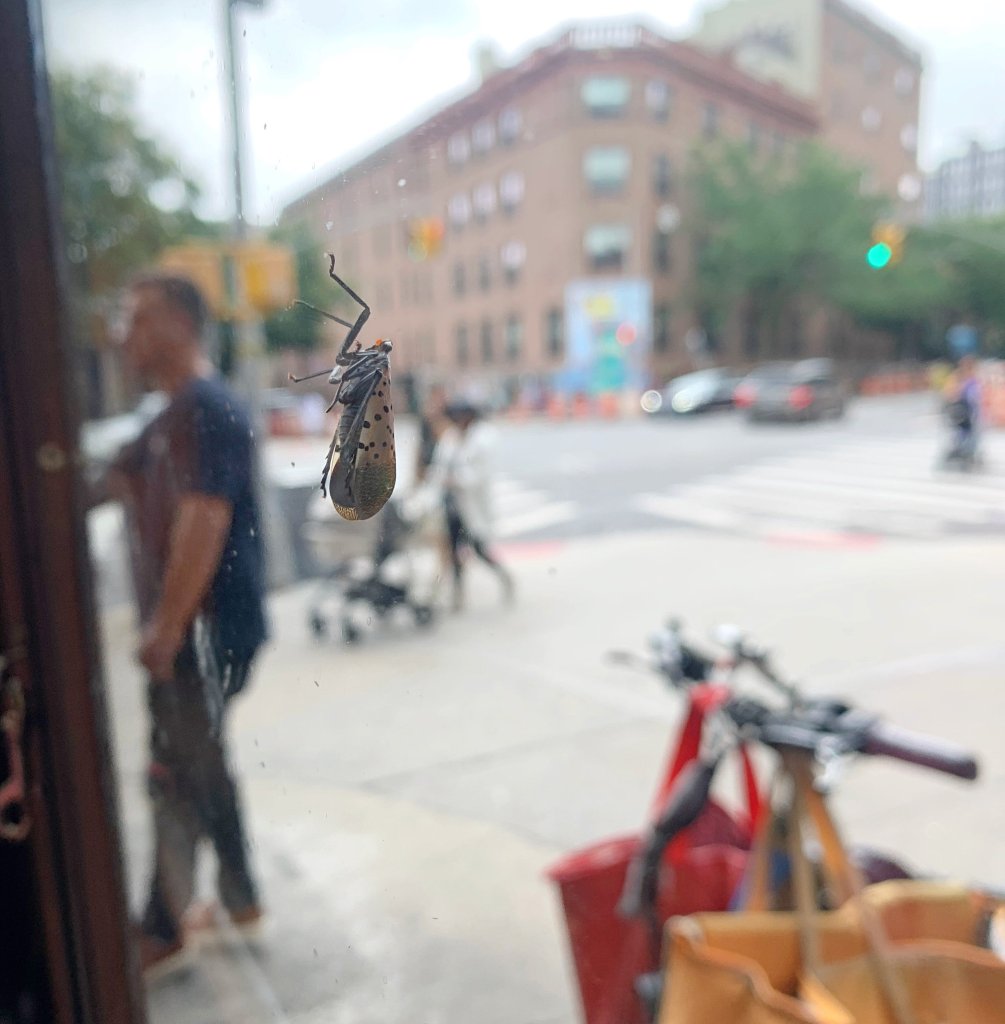
At one point on the walk, the sidewalk narrowed into a kind of tunnel, due to construction on the building next door. And for whatever reason, the pavement was littered with the lifeless bodies of spotted lanternflies. This is an insect pest, originally from southeast Asia, which has spread far and wide due to human activity (they lay their eggs on pieces of wood, which then get transported). Though the insect is actually quite beautiful—with brilliant red wings and an attractive spotted pattern—and though it poses no direct threat to people, New Yorkers were encouraged to kill them on sight for the threat they pose to agriculture and the environment generally.
By now, they’ve probably multiplied to such an extent that killing them doesn’t do any good; but we still did our part and murdered the three or four remaining living insects on the sidewalk.
“It’s like a level of a video game,” Greg joked, as we exited the lanternfly tunnel.
The best picture I’ve managed to get of a lanternfly, taken from inside a bodega.
Now we were entering the vicinity of Columbia University, whose presence stretches far beyond its main campus. One obvious sign that we were entering its orbit was the proliferation of bookstores and book stands. This was perilous for the both of us. Anyone who knows me is aware of my fondness for the written word. And Greg, well… he’s a history professor. If our odyssey was like a video game, then this level was far more challenging than the lanternflies. We had to resist the pull of knowledge.
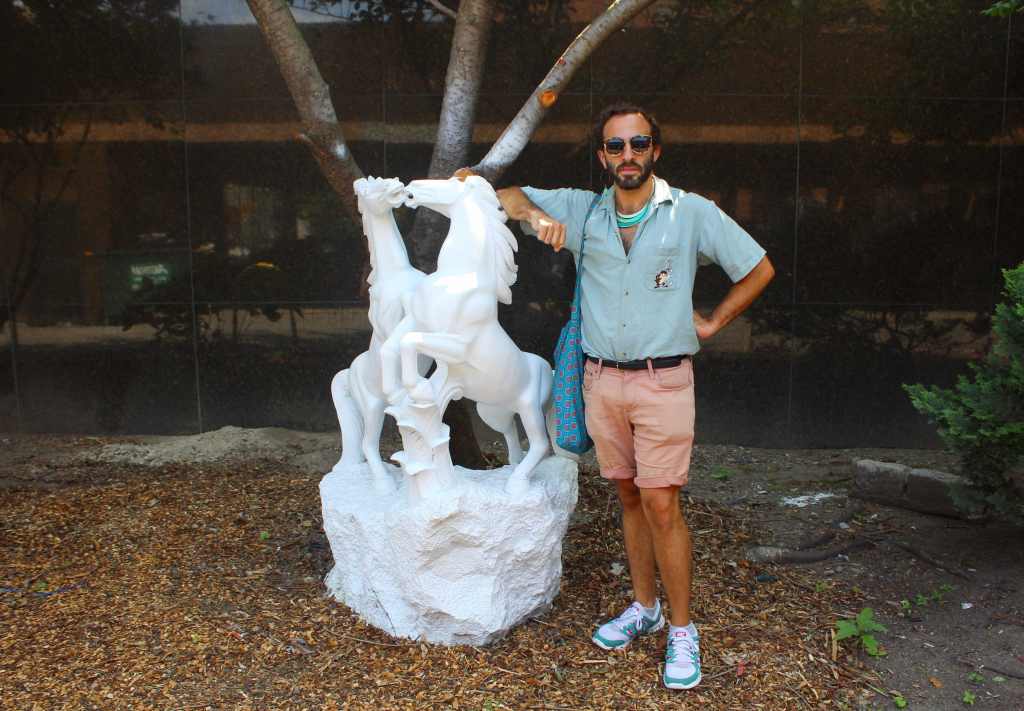
Greg looking phenomenal next to a strange statue adorning an empty parking lot.
I did, however, take the opportunity to buy Greg a book I’d been recommending him for some time: Times Square Red, Times Square Blue, by science fiction writer Samuel R. Delany.
Now, to give you some background, Rudy Giuliani’s campaign to clean up Times Square has often been celebrated as an example of successful urban redevelopment. Before Giuliani’s stint as mayor—that is, from the 1960s to the early 90s—Times Square was considered a rather seedy area, full of porn theaters, peep shows, and nightclubs. Far from a tourist attraction, it was an area most people tried to avoid. Its transformation from a symbol of the city’s decline to its star attraction is thus usually heralded as a triumph.
Delany calls into question this basic narrative, and he does so with stories of his own explorations—and sexual adventures—in the old, sordid Times Square. For a sex-positive, anti-gentrification, urban studies academic, and a proud New Yorker to boot (in other words, my friend Greg), this seemed like the perfect read.
The real highlight of this part of town was a visit to Tom’s Restaurant, the diner featured on Seinfeld. For such an iconic spot, it is wonderfully unpretentious, with reasonable prices and a classic diner atmosphere. We took the opportunity to order some milkshakes, and I heartily recommend the same to anyone in the area.
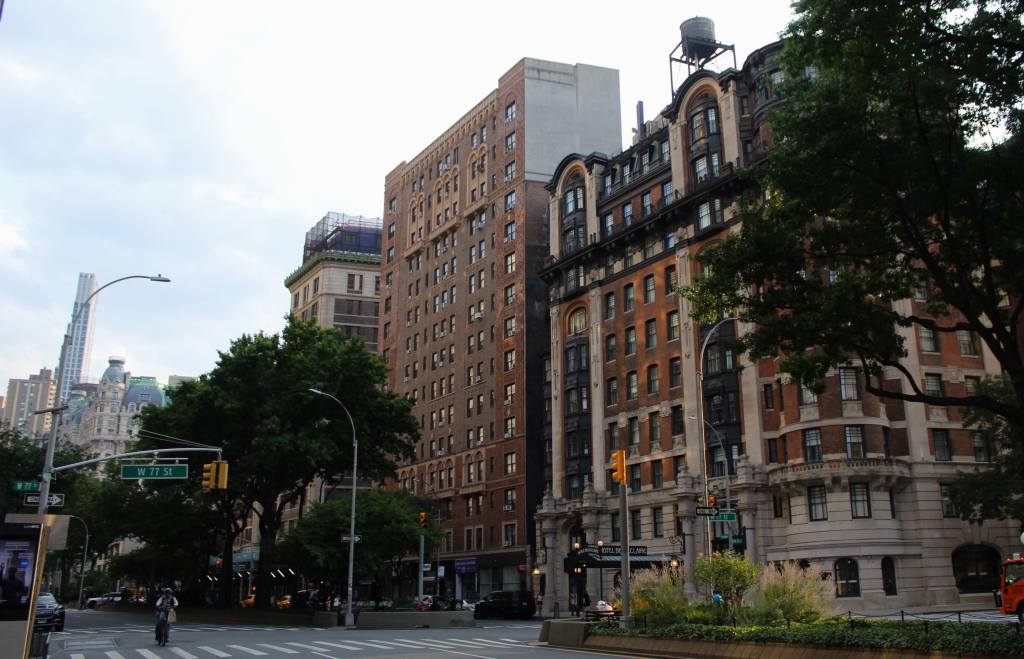
We kept going, moving out of Harlem and into the Upper West Side. This is easily one of the architectural highlights of the city, mainly due to the many ostentatious apartment hotels—the Dakota, the San Remo, the Hotel Belleclaire—that were built in the late 19th and early 20th centuries, by architects such as Emery Roth. Indeed, this part of Manhattan could easily rival the heart of Paris for its elegance and beauty. Even the subway station at 72nd street is a monument. Rather than try to explain any more myself, however, I will recommend this excellent video by Architectural Digest—as well as their YouTube channel generally. It is some of the best content available about the city.
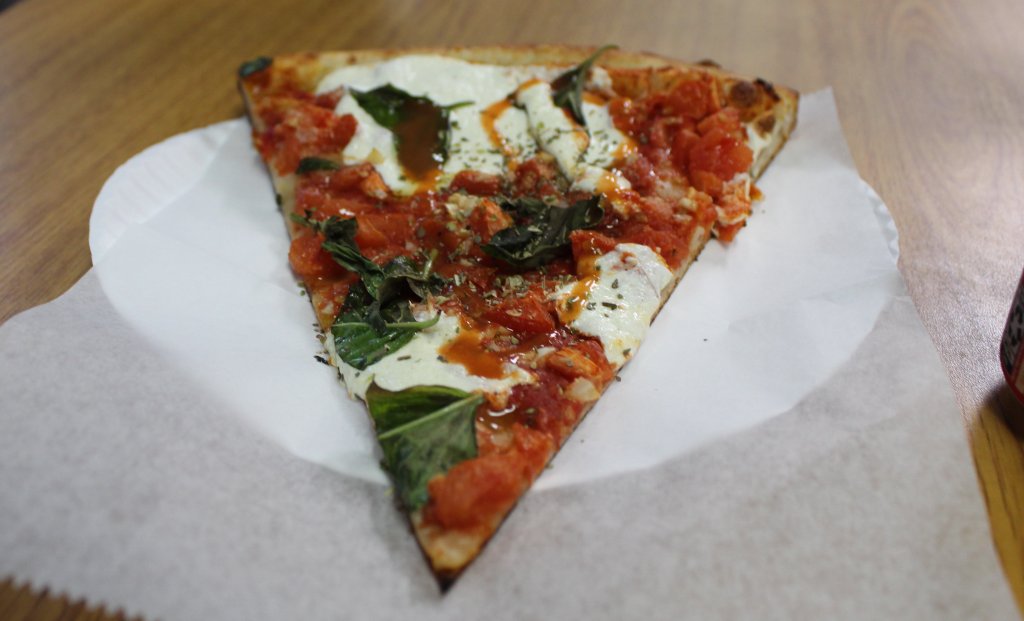
But I will pause to savor the pizza we had at one of my favorite New York spots: Freddie & Pepper’s. All of us ordered the same thing: a slice with tomato, basil, and fresh mozzarella. It was exactly what we needed to continue our walk.
Now, I would like to take a moment to consider the smells of the city. Though some, like pizza, are conspicuously good, for the most part Manhattan is malodorous: hot garbage, urine, car exhaust, bodies covered in sweat… But lately a new smell has taken over: marijuana. It is not exactly the most pleasant odor (at times it can smell remarkably like a skunk), but it is certainly omnipresent since the legalization, in 2021, of recreational cannabis.
One of the ideas behind legalization was to treat cannabis like wine or liquor, selling it at licensed stores. However, since the unlicensed distribution network was already (shall we say) quite robust, unlicensed stores and stands popped up throughout the city before the legal venues could get a foothold, much to the embarrassment of politicians. Indeed, a major government crackdown was taking place during the week of our walk, leading to the shutdown of over 750 illegal stores. Crackdowns notwithstanding, the city has certainly taken to legal weed with gusto.
The last major sight in the Upper West that we passed was Lincoln Center. We sat down to rest in the nearby Richard Tucker Park, while a bored-looking young woman sang operatic arias—quite well, really—in order to “fund her education.” Puccini and Verdi notwithstanding, I had the music of West Side Story in my head. It was here, after all, that the original movie was filmed—in the ruins of the demolished San Juan Hill neighborhood—and where the Steven Spielberg remake was set.
Greg, looking very serious about this walk.
Robert Moses enters this story once again, as it was the notorious commissioner who spearheaded the project—seizing the land from the working-class, multi-ethnic residents of the neighborhood, and then razing the property in order to make way for the city’s new bougie performing arts center. In other words, it was yet another chapter in the long history of Manhattan’s gentrification. At least Lincoln Center looks good.
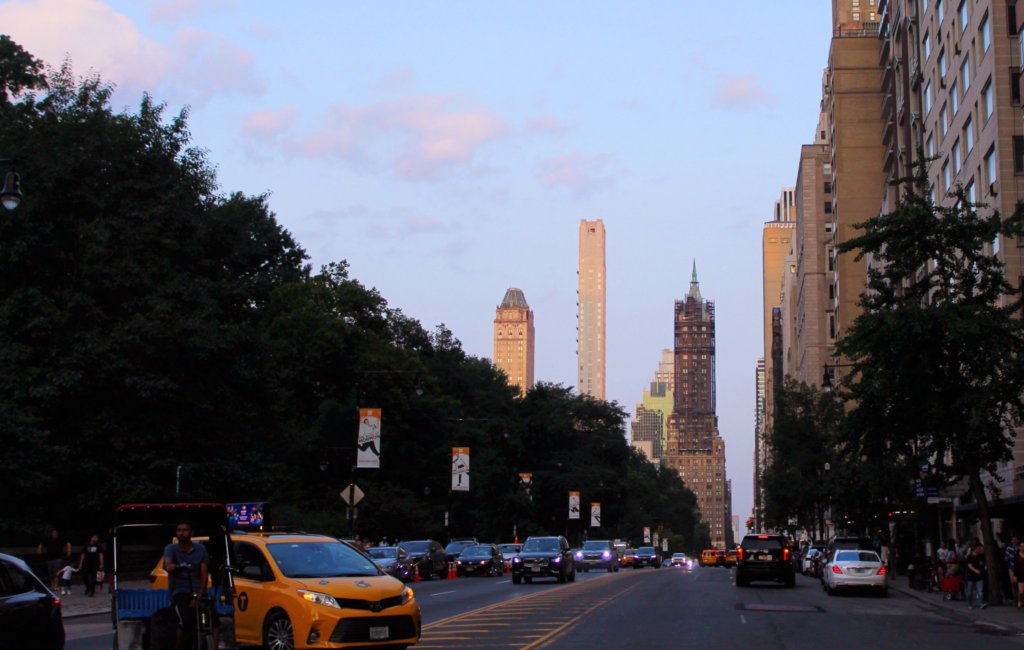
Finally, as Broadway slowly bent eastward, we hit the next major landmark on our walk: Columbus Circle. This meant that we had finally gotten below Central Park, and were officially entering Midtown Manhattan. The entrance to the park was bustling with activity, as hot dog vendors and the drivers of horse-drawn carriages and pedicabs vied for the tourist’s attention (and money). Yet what struck our collective attention was the large monument on the park’s southwest corner. We stared at it, wondering at its significance, until Jay looked it up on his phone:
“It’s a monument to the USS Maine!”
Now, you may be forgiven for not remembering the significance of this ship. This was an armored cruiser that exploded and sank in Havana’s harbor in 1898, with the loss of 268 sailors. And though the evidence that it had been deliberately attacked by the Spanish was weak at best, the ship’s sinking became a cause célèbre which led to the Spanish American War. Nowadays, neither the Maine nor the war itself (which was basically an American colonial power-grab) are much remembered or remarked upon by Americans. Enormous monuments notwithstanding, the war had a more lasting cultural impact in Spain, as the country’s embarrassing loss to the upstart United States prompted severe self-doubt among its intellectuals, who were dubbed the Generation of ‘98.
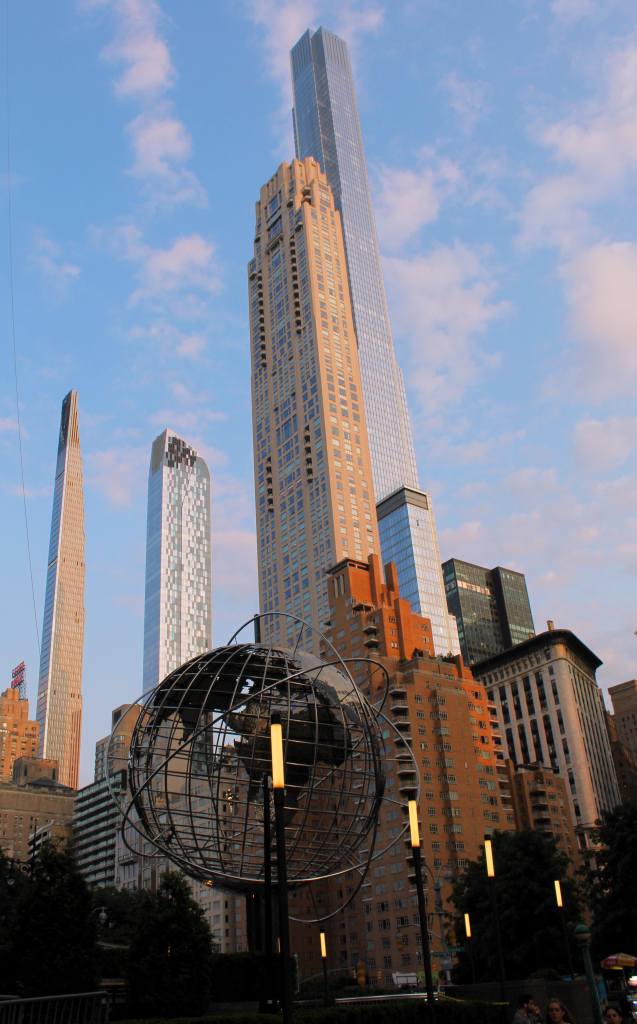
Above us, some of the tallest buildings in Manhattan soared off into the sky. This is Billionaire’s Row, a collection of supertall, pencil-thin, ultra-luxury apartment buildings at the bottom of Central Park. For me, though the skyscrapers are impressive as feats of engineering, the buildings make a dubious addition to Manhattan’s skyline—imposingly tall, but not particularly pretty. And, of course, it is rather depressing to have the city’s silhouette dominated by properties to be used as investments for the super rich.
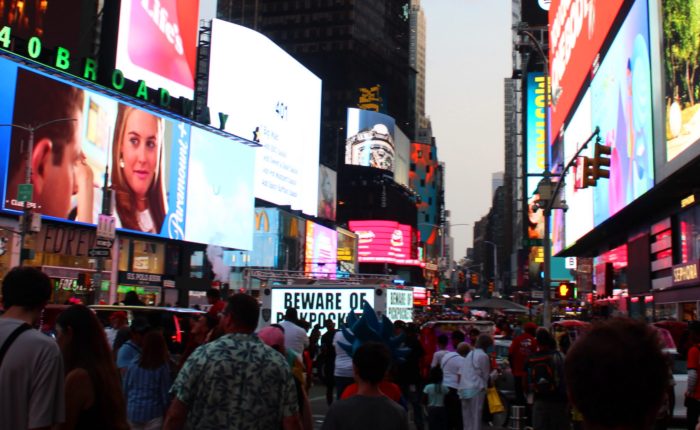
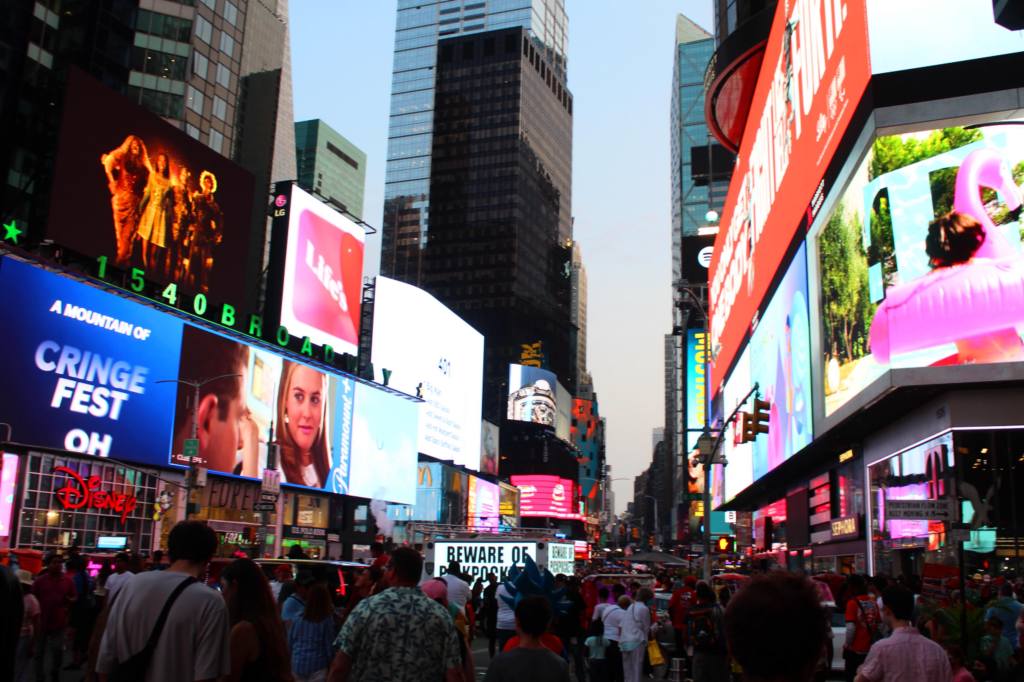
Almost as soon as we left Columbus Circle, we entered Times Square. Far from a discrete part of the city, Times Square seemed to spread impossibly far, its bright and suffocating tentacles strangling block after block. It seems unnecessary to describe the scene—the smothering crowds of gaping tourists, the blinding lights and flashing signs, the street acrobats occupying the sidewalks, the Elmos and Marios and Mickey Mouses (some with their helmets off, smoking a cigarette)—but I do want to mention the religious fanatic, who was standing on a street corner and yelling that Christianity had abandoned Jesus Christ. A man in a wifebeater stopped to shout “Fake news!” nonsensically at the preacher, and his young son did the same.
Greg and Jay took off like rockets—or, should I say, like real New Yorkers—once we hit Times Square, weaving and bobbing through the crowd like professional boxers. I could hardly keep up, though I did my best. It is a truth universally acknowledged by native New Yorkers that Times Square is to be avoided at all costs. And I have to admit that, by the time we got to the end of it—power walking in sullen silence through the crowds—I yearned for a few porn theaters or gogo bars to scare away the tourists. In other words, Samuel R. Delany may have had a point.
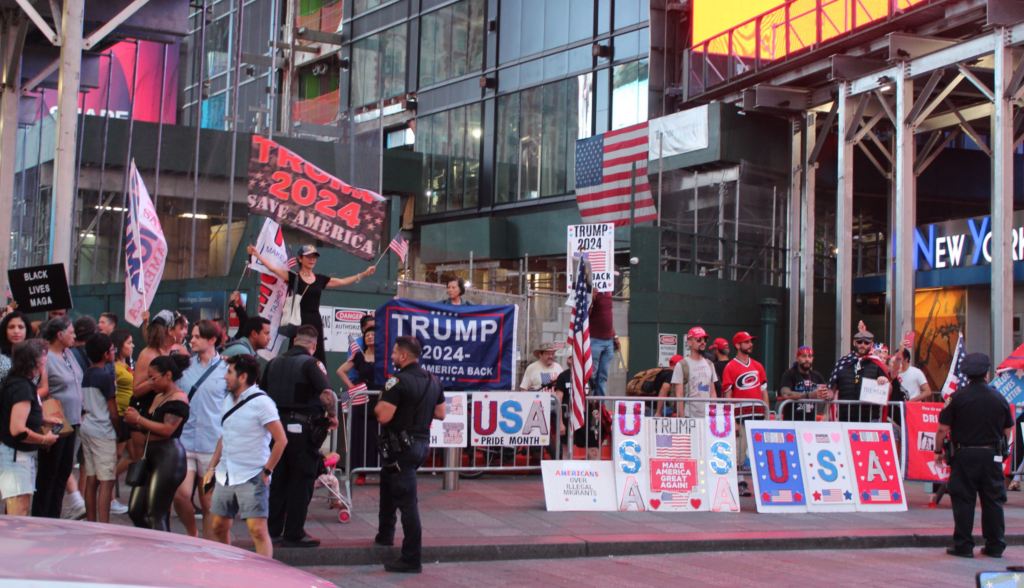
Right as we were approaching the southern end of Times Square, and the limit of our tolerance, we passed by a glowing neon American Flag, in front of which a drag queen was yelling into a megaphone, leading a boisterous anti-Trump rally. Just across the street there was a decidedly smaller pro-Trump rally, trying in vain to maintain a similar energy-level. My favorite character was a very calm black man who stood next to the Trumpers, casually holding a Black Lives Matter sign and chatting to his friend.
From here on, the walk entered its most grueling phase. The sun had set and we were all tired—especially me. In perfect frankness, I was suffering from an affliction that often plagues me during my summers in New York: chafing. Suffice to say that, by the time we got past 42nd street, every step I took was a minor agony. Added to this, I had chosen badly and worn my sandals for the walk, which meant my toes were grinding against pebbles and dirt, covering the sides of my feet in blisters.
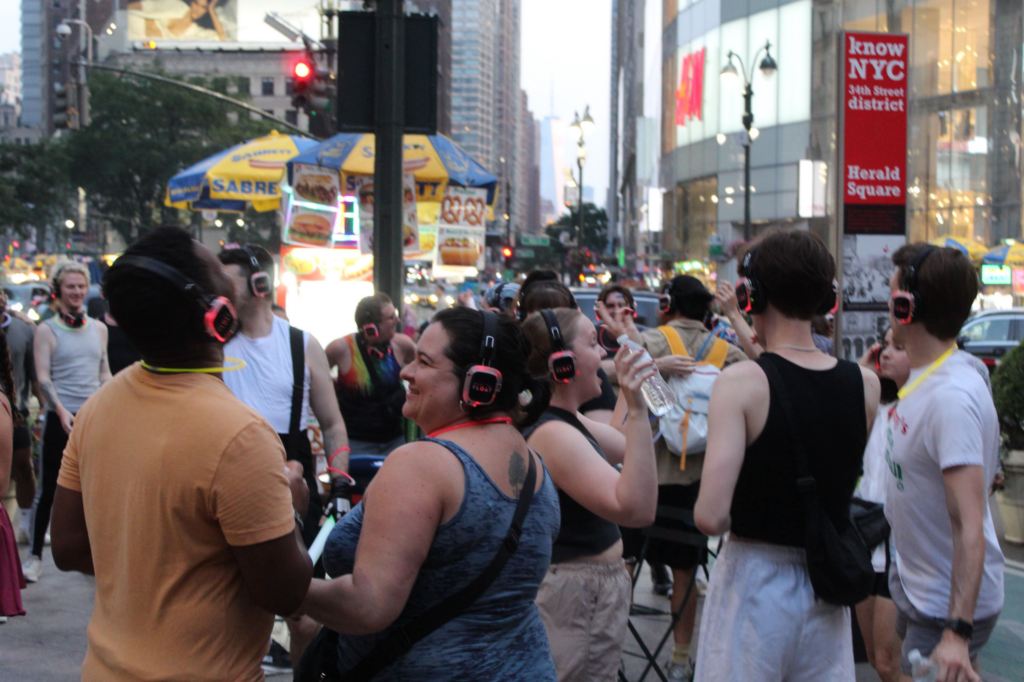
By the time we got to 30th street, I was waddling like a duck, and in no mood to appreciate architectural treasures. In any case, the city was quite dark by now—and surprisingly dead. From 42nd street to 14th, we did not pass by a single store that attracted our attention. And though it was a Saturday in midtown Manhattan, the streets were surprisingly empty, mostly consisting of people dressed up for expensive outings elsewhere.
A silent rave we passed, in Herald Square
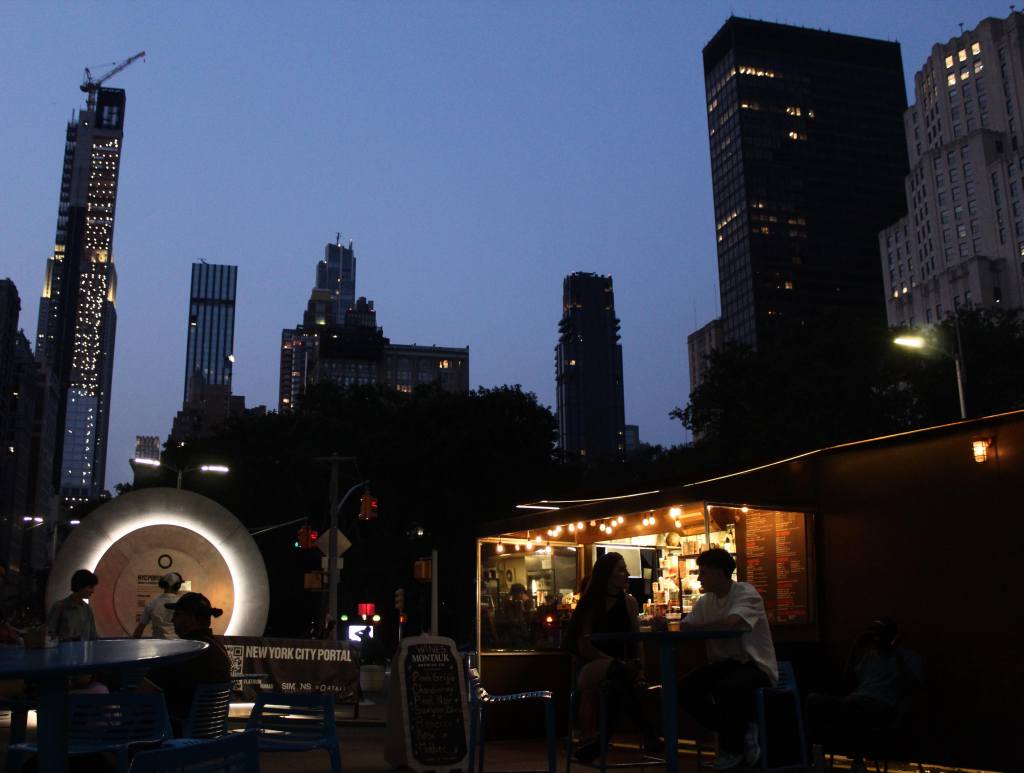
Finally, the Flatiron Building came into view. But something else attracted our attention, a large circular TV monitor. This was the New York-Dublin Portal, an art installation by Benediktas Gylys that opened this year. It is a simple but intriguing concept: a two-way video call so that residents of the two cities can wave at one another. But bad behavior shut down the portal for a week in May. People from both cities couldn’t resist exposing themselves, and a few on the Dublin side had the bright idea to display images of the September 11 attacks.
I was looking forward to waving to some Dubliners (despite the risk of getting flashed). Unfortunately for us, by the time we arrived the portal was closed for the day.
We did at least pause for a drink at an outdoor food stand. It was well past nine o’clock at night and we were all pretty ragged. The prospect of accepting defeat was seriously raised. We did not have much more in the tank. For my part, I badly wanted a shower and to change out of my sticky, stinky clothes. But I wanted to finish the walk even more. And when we saw on our phones that we had just over an hour to go, we decided we had to finish what we started.
Back on our feet—though walking slow—we got to Union Square. In normal times, this is one of my favorite parts of Manhattan (which is generally lacking in green space away from Central Park), but now I just felt a sense of relief that we were recognizably downtown.
I did pause to look up at Metronome, an art installation at the bottom of the park. It consists of a hole that periodically blows smoke rings, next to a series of numbers which don’t make any obvious sense. For years, I would wonder what the numbers might mean, to no avail. It turns out that the digits are a strange kind of clock, displaying (from left to right) the hours, minutes, and seconds from the last midnight, and then the seconds, minutes, and hours to the next one. Not particularly useful, I’d say.
However, since 2020 the display has been repurposed to make a Climate Clock, which counts down years and days to 1.5°C of warming—a number considered to be a threshold for many of the worst effects of climate change. As of this writing, we’re slated to pass over this threshhold on July 21, 2029. Yikes.
Just down the street we passed by one of my favorite spots in the whole city: The Strand Bookstore. It was probably fortunate that, by the time we limped by, it was closed for the day. We couldn’t have survived another delay.
This was the final stretch. The street numbers were falling, 4th, 3rd… until the numbers ceased, and all of the streets had names. We crossed Houston street (pronounced “Howston” in contrast to the city of “Hyooston”) and into SoHo. This was Old Manhattan, Dutch Manhattan, New Amsterdam—the original, chaotic colony, whose criss-crossing streets contrast sharply with the ordered grid of the city’s later expansion northward.
We walked on in relative silence. There was nothing more to say—except complaints. By now I looked as bad as I felt, hobbling down the sidewalk, trying my best to tune out the pain from my lower limbs. I did not have the mental energy to contemplate the African Burial Grounds National Monument, nor to even register City Hall, St. Paul’s Chapel, or Trinity Church…
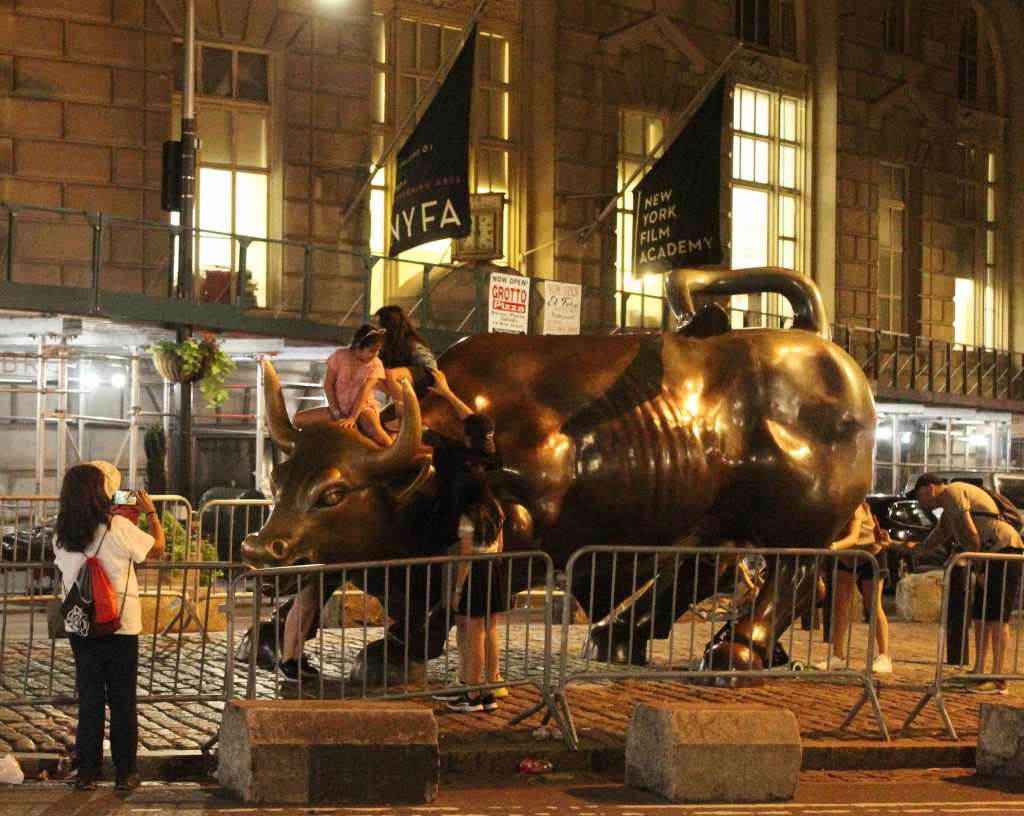
It was only when we got to the financial district, and passed the iconic Bull Statue, that my spirits lifted. I could smell the water now. We were close.
The final stretch felt like a triumphal march, as we walked through the “Canyon of Heroes.” These are black granite plaques commemorating all of the ticker-tape parades held in New York’s history. You see, it used to be customary to fête important visitors with large parades, in which shredded paper would be thrown everywhere. The tradition started as a spontaneous celebration of the Statue of Liberty’s dedication. Most of the celebrants were visiting dignitaries, heads of state, military heroes, and—most prominently—great aviators. It is a rather charming reminder of the intense excitement of the early days of trans-Atlantic flight.
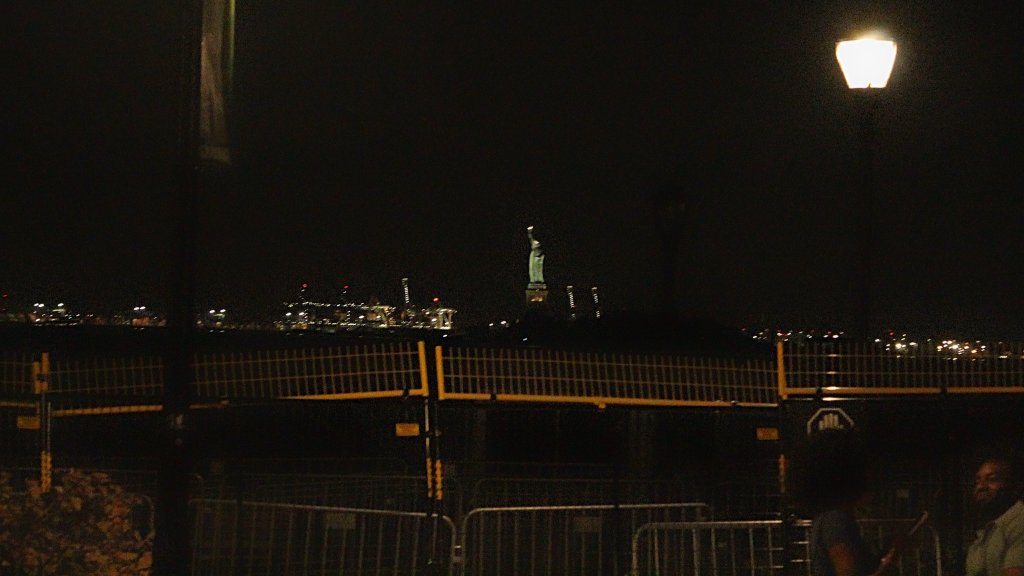
We finally exited Broadway and entered the Battery. The air was notably cooler, the sounds of the city mixed with crickets. There were surprisingly few people about. We turned a corner and, in the distance, Lady Liberty herself came into view—on the other side of a chain-link fence (a rather depressing image, really). I sat down heavily on a bench, too tired and sore to feel much of anything but relief. But we had made it, from the top to the bottom. It had only taken us 10 hours.
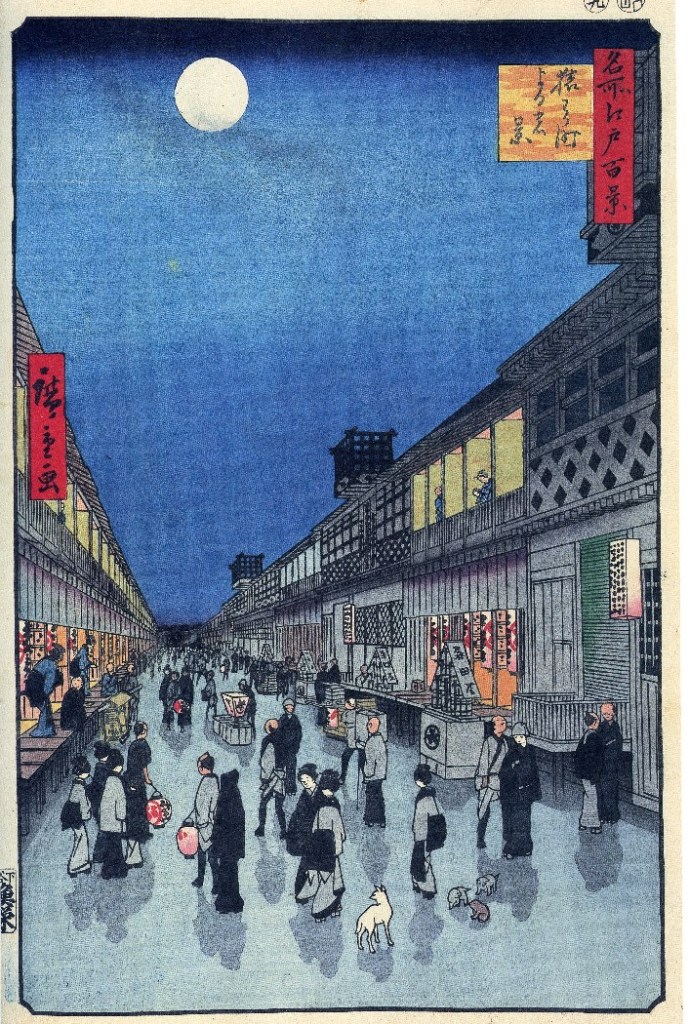
As an epilogue, I wanted to pay my respects to perhaps an unlikely hero of this post: Utagawa Hiroshige. A few weeks previous to this walk, the three of us—Greg, Jay, and I—had seen an exhibit in the Brooklyn Museum of Hiroshige’s celebrated series of woodblock prints, One Hundred Famous Views of Edo.
What impressed me most in those images was Hiroshige’s ability to display so many different aspects of the city that would become Tokyo: its parks, its seasons, its festivals, its streets and buildings, and its people—from priests to prostitutes. It struck me as remarkable that Hiroshige was able to find such beauty in familiar surroundings. But perhaps all he needed for inspiration was a very long walk.

 Lotz in Translation