El asesinato de García Lorca by Ian Gibson
My rating: 5 of 5 stars
Sometimes the simple act of remembering is political. History is, unfortunately, replete with crimes that one government or another would prefer to remain hidden. And, certainly, forgetting is probably easier for everyone involved—less traumatic, more convenient—even, perhaps, for the victims. Thus, whenever some busybody like Ian Gibson begins stirring up old trouble, the accusation of “opening up old wounds” is inevitably trotted out (ironically, by the ones who did the wounding in the first place).
And yet, even if it is not entirely logical—even if what is done is done, and nothing can change that—some sense of moral duty, of obligation to victims who are beyond all human help, seems to compel us nevertheless to reach back into the past and seek justice. This book is imbued with that sense—perhaps a quixotic sense—of ethical duty, as Gibson attempts to nudge the moral balance of the universe back in the right direction.
He first establishes that Lorca was anything but the apolitical flower child that he is sometimes portrayed as. It is true that Lorca was perhaps somewhat naïve and, in general, was averse to party politics (he repeatedly refused to join the communist party). But he was politically active and unambiguously allied with the left, as was evident by several public declarations. Indeed, the idea that Lorca was, in his final days, converting to the fascist cause—an openly homosexual poet who dramatized the evils of conservative Catholicism!—was never anything but laughable.
Gibson then does his best to establish the events that lead to Lorca’s death in Granada, using interviews with witnesses (admittedly many years after the fact) to pin down as many details as he can. In the process, he gives the reader a sense of the climate of terror and repression that engulfed Granada in the opening days of the military uprising—jails packed to bursting, mass graves filled by firing squads, a knock on the door at mightnight to go “take a walk.” In the process, he also lays to rest another myth of Lorca’s murder, that he was somehow killed by uncontrollable elements of the falangist party—a random act of violence, in other words. On the contrary, Lorca’s death was the product of an intentional campaign of “purification,” approved of and organized by the authorities.
This book might not have had such an impact on me had I not visited Granada as I was on the final pages. Though I had read many of Lorca’s works before the visit, he was still just a historical personage for me—one of Spain’s many dead poets. But visiting his former houses (there are several, as his family was very wealthy) transformed him into somebody startlingly real and close. I saw the piano that he liked to noodle on, the writing desk on which he wrote his most famous plays, and even hand-drawn theater backdrops to be used in a puppet show for his baby sister.
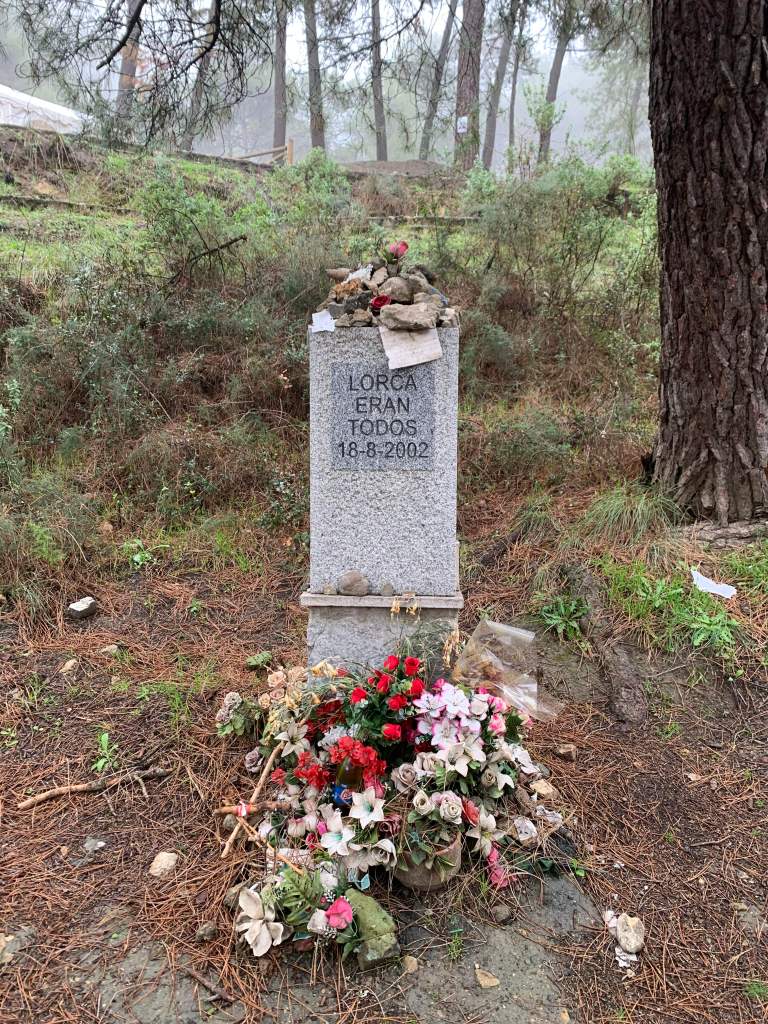
This trip culminated in a visit to the Barranco de Víznar, the place of his execution. We arrived on a foggy Sunday morning and followed the path into the woods. Soon, we came upon several white tents, which covered the excavations sites of mass graves. The trees around the site were covered with laminated posters bearing the names and faces of those executed there—professors, politicians, farmers, pharmacists, music teachers… In the center was a simple memorial covered in flowers, with the inscription “They were all Lorca.”
So far, the remains of dozens of individuals have been recovered there by a team of investigators, though none have yet been identified by DNA tests. That this excavation had to wait nearly 100 years to take place is a measure of the silence—imposed, in an attempt to forget—that followed the Spanish Civil War. But relatives of the victims have kept their memories alive, and now they are perhaps receiving some modicum of justice. Even today, memorializing these victims takes courage. Just last week, a hiker was assaulted at that very place by a man screaming “There aren’t many buried here!” The hiker was hospitalized. But the work continues.
View all my reviews

 Lotz in Translation
One thought on “Review: The Assassination of García Lorca”