One of the best parts of living in Spain is the restaurant scene. The country is exceptional simply for the number of dining establishments. If I had to guess, I would say that there must be more bars and cafés per capita here than in any other country in the world. And though you may not think so, this alone is quite a wonderful thing, since you really never have to worry about where you are going to eat or drink. Chances are, there will be something close.
But in this post I want to focus, not on the quantity, but on the special quality of Spanish restaurants. And to do this, I think it will be better to discuss one exemplary bar rather than to speak in abstractions. For this, I went across the street to one of my favorite local bars, Los Gauchos, and interviewed them. These are my discoveries.
Gauchos is located in the Pacífico neighborhood, which is fairly central but which doesn’t attract much tourism. It is in many respects a typical Spanish bar—or, as the Spanish say, “un bar de toda la vida” (a lifelong bar). That is, it is the sort of establishment you might find in the north or the south, the east or the west, and which retirees and children would both recognize.

According to Javier—the son of the owner—Gauchos has been open for about thirty years. It was purchased from previous owners, who had run the bar for fifteen years before that. A lifelong bar indeed. (It was the previous owners who named the bar after the famous “gauchos,” who were something like South American cowboys.)
The bar has been around so long that the neighborhood has changed around it. According to Javier (who has worked here since he was 16) and the jovial bartender Melchor (who has worked here since it opened 30 years ago), Pacífico has become more residential in recent years. In past decades, the area was full of offices and industry, and consequently was a ghost town on the weekends when nobody had to work. Lately, they’ve noticed that rising rents are pushing younger people out of the neighborhood, further into the peripheries of the city.
Now, my country has dive bars and local restaurants aplenty. But I think the closest thing the United States has to this sort of restaurant is, perhaps, a diner—a privately-owned restaurant which nevertheless has a recognizable aesthetic and a fairly standard menu. However, the Spanish “bar de toda la vida” is quite different in being, well, a bar. There is simply no place in my country where you can get a coffee and toast in the morning, eat a multiple-course meal at lunch, and have a gin tonic with your friends until late at night. The typical Spanish bar is an all-in-one experience.
This makes Gauchos, and other bars like it, a kind of de facto neighborhood gathering place. In the morning it attends to the mad rush of commuters on their way to work. Around lunchtime, besuited office workers might sit down for a leisurely lunch. And at night, the sidewalk is full of neighbors having a drink. Partly because apartments in Madrid are often small, friends tend to meet in bars rather than in one another’s houses. The neighborhood bar thus plays an important role as the communal living room.
Many times I have witnessed a grandpa or a grandma come after picking up their nieto from the nearby school. The other night, three generations of a family came in to hang out. Meanwhile, a man with a guitar sat down to drink peppermint tea and read a comic book. The most raucous nights are when there is an important football match, and the bar and even the pavement fill up with people watching the game on the large TVs, screaming in triumph or agony at every development. In short, the clientele is a cross-section of the neighborhood itself.
As I mentioned, the typical Spanish bar is similar to the American diner in having a standard menu. Just as the latter will have pancakes, hamburgers, and milkshakes, so the former will have bocadillos, tostadas, and tortilla de patata. If Gauchos’s menu is exemplary, it is in having even more reasonable prices than usual. You can order a full plate of food for about 5 euros. The lunch menu—which includes two courses, a drink, and dessert—costs ten euros and fifty cents.

The low prices are not incidental, but essential to any neighborhood Spanish bar. It is a place for anyone and everyone to come. This is a major contrast with most bars and restaurants in the United States, which are seldom cheap (especially after tipping), and which normally try to distinguish themselves with ornate decorations or unusual food options. By contrast, you can buy a cup of coffee in Gauchos and sit there for hours without anyone bothering you.
The contrast goes deeper. Neighborhood bars in Spain are essentially public, open spaces, where anyone can come in and feel at home, whereas bars in the United States are very different. Gauchos, for example, is bright inside and there is never any music playing. (Hemingway would call it a “clean well-lighted place.”) You don’t have to shout to have a conversation and you don’t have to squint to read. By contrast, I often find the darkness and loudness of American bars to be sort of oppressive. You can seldom forget that the bar is private property and that you are not the owner.

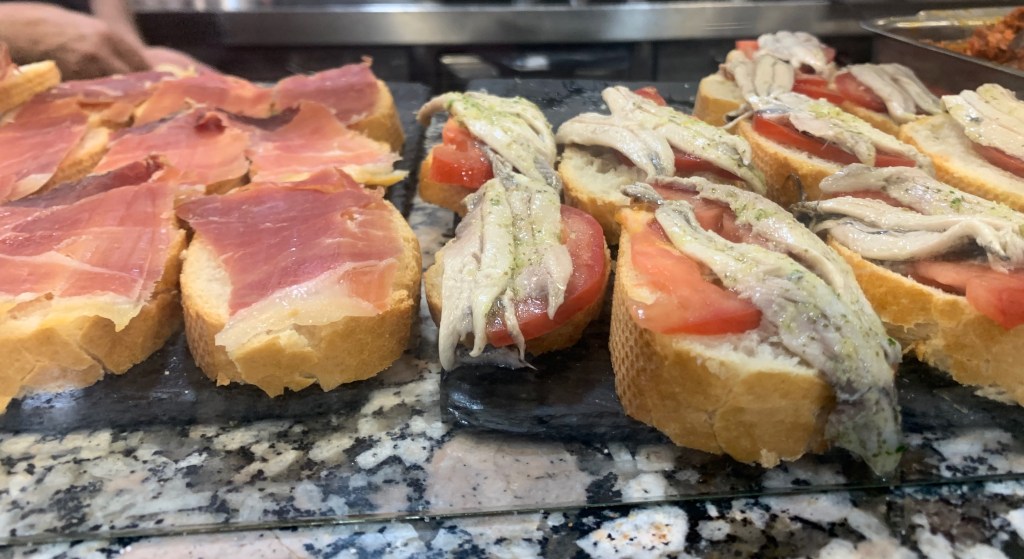
The aesthetic of Gauchos is extremely simple. The walls are white, and the chairs and tables are completely plain. As is common in Spain, the bar itself has a large glass display cabinet that is even refrigerated, where the customer can see the various options for tapas,* or even raw meat and pickled fish to be used later. The sign outside consists of simple plastic lettering against a white background. Below this is the iconic toldo verde (green canopy), where the patrons gather to escape either the sun or the (rare) rain.
(*There seems to be some confusion among Americans as to what tapas are. In Madrid, a tapa is just a small bit of food included with your drink. This is normally just a few olives or some mixed nuts. But in a good place like Gauchos, you might get a mini sandwich, some fried chorizo, or a plate of patatas bravas.)
There is, in short, hardly any decoration to speak of, which is why British journalist Leah Pattem, in her popular blog, has coined the term “no-frills” for this sort of establishment. It is an apt description, and I think she deserves much credit for bringing this sort of bar—so common as to be taken for granted by many—into the spotlight.
Indeed, for my money the neighborhood bars of Spain are a cultural resource as precious, in their own way, as the Alhambra or the Sagrada Familia. And I think that the people who run them deserve a great deal of credit. It is very hard work—long hours, few days off, both physically and emotionally taxing. So I think we all owe a debt of gratitude to the people who form the backbone of the neighborhood’s social life.

In Spain, as elsewhere, the existence of local restaurants is threatened by ongoing gentrification and the spread of corporate restaurant chains. These trends, if they continue, threaten to turn every city corner into the soulless copy of every other—where identical freeze-dried food can be purchased at identical prices from identically uniformed workers. But if the large crowds that gather around Gauchos every evening are any indication, the Spanish have not lost their taste for their bares de toda la vida—and I hope they never do.

 Lotz in Translation
Oh, the darkness of bars, not just in the US by any means. Also the noise of (what I hear as) bad music, here in Australia and in Geneva. We have a bar in Adelaide called bibliotheca which has books in shelves, but when I called to enquire further I was told it was dark, and if you wanted a non-noisy environment, maybe early in the week. I got the impression nobody had ever read in there, perish the thought.
We used to go to Les Bergues in the Four Seasons in Geneva a lot, books in hand. When they turned the lights down at some point in the evening, they often especially catered for us by giving us our own light or some such. I guess if you are okay paying $15 for a pot of tea, there are benefits.
LikeLiked by 1 person
That’s some expensive tea! But worth it if it allows you to read in peace.
LikeLike
There are a lot of cafes in Australia which basically expect you to have a drink about every 20 minutes, or they want you out, so you end up spending about the same anyway or you leave before you’ve found the page you are up to. Very happy to pay more (and you get a pot, so you get a few cups) and be left alone, which the posh hotels are very good at.
LikeLiked by 1 person